
 The hiring timeline for AI roles tells the story clearly. Across commonly needed positions, standard recruiting consistently falls short of project timelines:
- AI Engineer (general): 90–120 days average time-to-fill (LinkedIn/Arsum, 2026)
- Senior LLM or Machine Learning Operations specialist: 90+ days; companies offering below-market compensation face up to 114 days (Acceler8/Korn Ferry, 2026)
- Natural Language Processing Engineer: 6–10 weeks for mid-to-senior level (KORE1, 2026)
- Data Scientist: demand up 15% over three years with supply consistently lagging (McKinsey State of AI, 2025)
For teams working against product deadlines, hiring cycles of that length are a structural problem — not a one-time inconvenience.
AI staff augmentation is a direct response: vetted AI specialists integrated into your team, under your management, without the overhead or delay of a full-time hire.
1. What Is AI Staff Augmentation?
AI staff augmentation means bringing in external AI specialists — Machine Learning engineers, Data Scientists, Natural Language Processing engineers, LLM developers — who work as part of your team. You set direction. They operate inside your tools, your sprints, your workflows.
Two distinctions matter:
- Managed AI services With managed services, a vendor owns execution and delivers an outcome. While you can track progress through weekly or monthly check-ins, companies without in-house technical members are heavily reliant on the vendor’s judgment throughout — with limited ability to course-correct independently. More critically, project scope is fixed before work begins. Any change to requirements triggers a re-estimation process that takes time, extends timelines, and creates cost overruns that are difficult to predict. This applies even to companies that do have technical staff on the client side.
- Direct hire Direct hire carries a 2–4 month hiring cycle with no guaranteed end date — you simply do not know when the right candidate will accept an offer. For teams with a fixed product launch or feature release deadline, that uncertainty is a real risk. Staff augmentation gives you a defined timeline, the expertise you need, and the ability to scale the team up or down as project demands change. It can also run in parallel with a direct hire search, increasing your chances of having the right person in place when you need them.
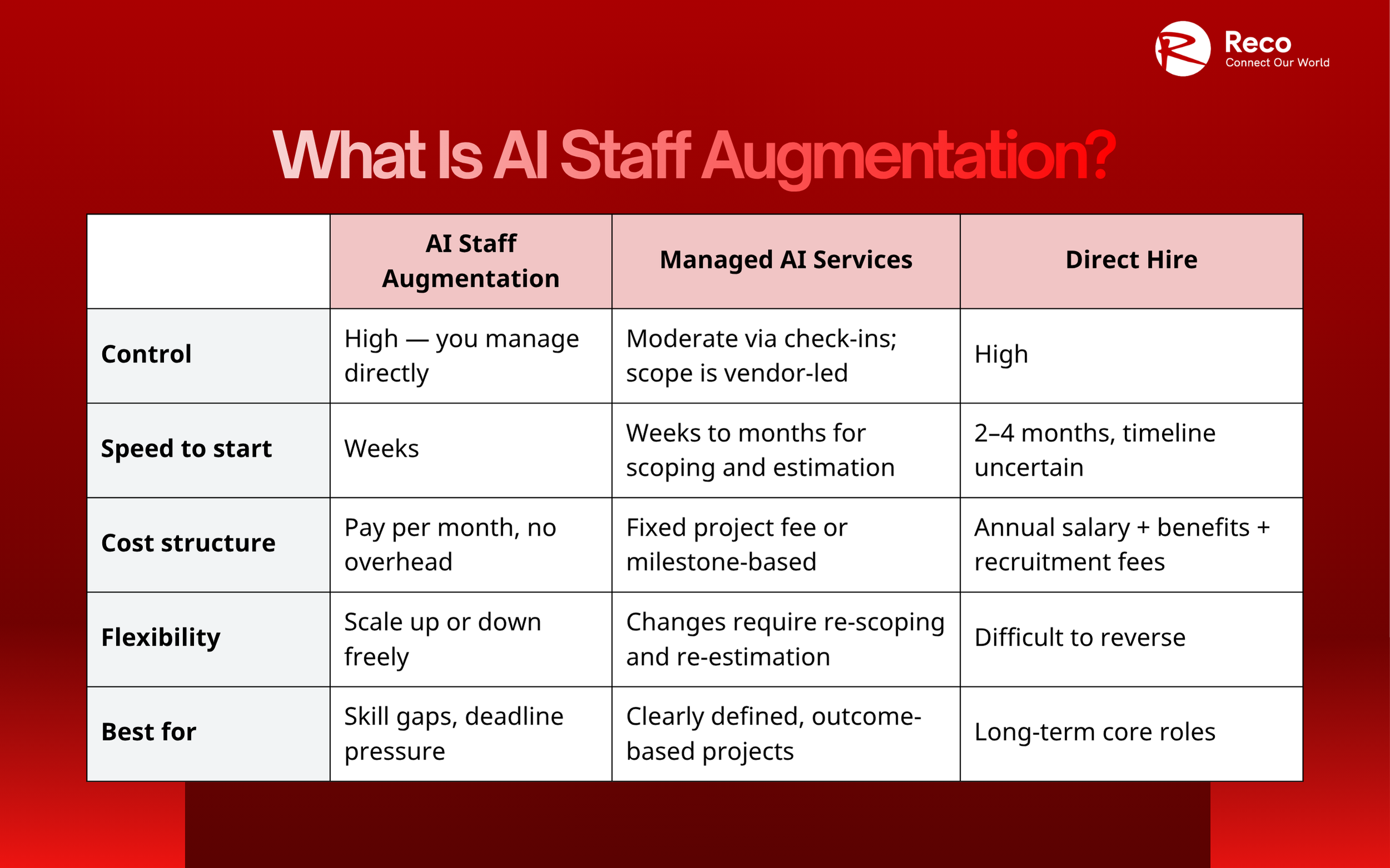
| AI Staff Augmentation | Managed AI Services | Direct Hire | |
| Control | High — you manage directly | Moderate via check-ins; scope is vendor-led | High |
| Speed to start | Weeks | Weeks to months for scoping and estimation | 2–4 months, timeline uncertain |
| Cost structure | Pay per month, no overhead | Fixed project fee or milestone-based | Annual salary + benefits + recruitment fees |
| Flexibility | Scale up or down freely | Changes require re-scoping and re-estimation | Difficult to reverse |
| Best for | Skill gaps, deadline pressure | Clearly defined, outcome-based projects | Long-term core roles |
2. Why Demand Is Growing Now
Three pressures are converging simultaneously.
Talent shortage is structural. McKinsey’s State of AI (March 2025) names data engineers and data scientists as the most in-demand AI hires globally, with supply lagging for Python, Machine Learning, and cloud infrastructure skills. Nearly 70% of generative AI projects stalled in 2025 due to talent gaps and engineering complexity (Gartner, 2025). Meanwhile, 76% of employers report difficulty filling AI roles despite increased budgets (Skillsoft/Pluralsight, 2025).
Compensation has moved fast — and monthly costs add up. As of 2025–2026 market data (KORE1):
| Level | Annual salary (US) | Monthly equivalent |
| Entry level (0–2 years) | $120,000–$150,000 | ~$10,000–$12,500 |
| Mid-level (3–5 years) | $150,000–$220,000 | ~$12,500–$18,300 |
| Senior (6+ years) | $200,000–$312,000 | ~$16,700–$26,000 |
These figures are base salary only, excluding payroll taxes, benefits, recruitment fees, and onboarding costs. For project-based work that may last 3–12 months, carrying a permanent headcount at these monthly rates rarely makes financial sense.
Vietnam as an alternative talent market. Vietnam has over 530,000 active IT professionals – including experienced mid-to-senior engineers in Machine Learning, data science, and AI infrastructure who regularly work with international clients across Singapore, Australia, and Japan. The total cost of engagement is a fraction of US or Western European equivalents, not because the talent is cheaper in quality, but because the market is different. Local compliance, payroll, and employment obligations are handled entirely by the provider. No local entity required.
Hiring AI talent in Vietnam without a local entity? Reco's Staff Augmentation service gives you direct access to vetted IT professionals with payroll and compliance fully handled. See how it works →3. When to Use AI Staff Augmentation
Use it when:
- A specific skill gap is blocking a time-sensitive deliverable
- You need direct control over execution and priorities
- The project scope may evolve and flexibility matters
- You want to evaluate talent before considering permanent arrangements
4. What Roles Can You Augment?
| Role | Core Focus | Common Use Cases |
| Machine Learning Engineer | Model training, deployment, optimization | Recommendation engines, fraud detection |
| Data Scientist | Experimentation, statistical modeling | Churn prediction, demand forecasting |
| Machine Learning Operations (MLOps) Engineer | Deployment pipelines, model lifecycle | Deployment automation, production monitoring |
| Natural Language Processing / LLM Engineer | Large language model fine-tuning, Retrieval-Augmented Generation systems | Chatbots, document intelligence |
| AI/ML Infrastructure Engineer | Graphics Processing Unit clusters, distributed training | High-throughput inference, training pipelines |
| Prompt Engineer / AI Systems Designer | Prompt architecture, LLM workflows | Agent-based systems, enterprise AI tooling |
| Computer Vision Engineer | Image and video recognition | Manufacturing quality control, medical imaging |
| AI Product Manager | Roadmap, stakeholder alignment | AI strategy execution |
For clients in fintech or healthcare: some providers carry AI safety specialists covering model explainability, bias auditing, and compliance documentation — worth asking about explicitly if relevant.
Read more: Top 16 Trusted IT Staffing Agencies in Vietnam for Top-notch Tech Talent in 20265. How the Process Works
- Skills gap analysis. Define which capabilities are missing and where they are blocking progress. For AI roles, go beyond seniority level — capture framework preferences, inference requirements (real-time vs. batch), and data residency constraints. Vague briefs produce misaligned candidates.
- Candidate matching. The provider screens against your requirements and delivers a shortlist of pre-vetted profiles. Quality here depends entirely on whether the provider’s screening process is AI-specific or repurposed from general IT vetting.
- Onboarding and integration. Augmented specialists join your existing workflows — same tools, same stand-ups, same sprint cycles. Treat them as team members from day one, not external contractors. Exclusion from planning rituals is the most common cause of underperformance in this model.
- Ongoing management and scaling. You manage direction. The provider handles HR administration, local payroll, and compliance. Scale up or down as the project evolves, without restructuring permanent headcount.
6. How to Choose a Provider
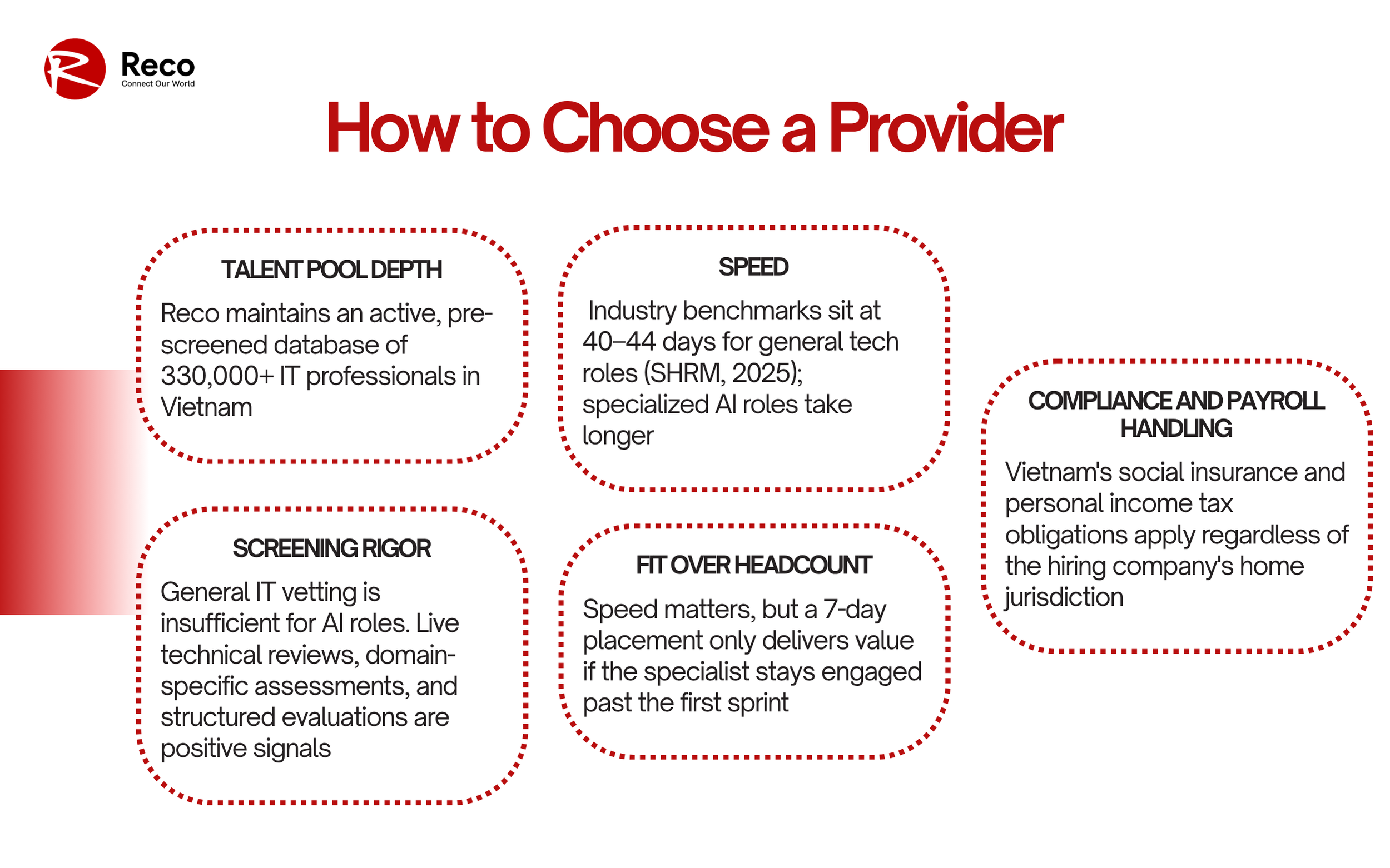
Talent pool depth. Most providers fill AI roles by searching general job boards when a request comes in. Reco maintains an active, pre-screened database of 330,000+ IT professionals in Vietnam — including experienced Machine Learning, data science, and AI infrastructure engineers — built over 7 years and 3,000+ placements across Tech, BFSI, and E-commerce clients. That existing pipeline is what makes a 7-day placement cycle credible.
Screening rigor. General IT vetting is insufficient for AI roles. Live technical reviews, domain-specific assessments, and structured evaluations are positive signals. Providers using AI-enhanced sourcing and matching tools — rather than manual search alone — tend to surface more accurate profiles faster, particularly for niche roles. Reco’s process combines AI-enhanced tools with a 330,000+ IT candidate database, which directly affects profile quality at first submission.
Speed — and what it actually means. Industry benchmarks sit at 40–44 days for general tech roles (SHRM, 2025); specialized AI roles take longer. Reco runs two models: RECO 7 for headhunting (target: 7 business days) and Reco Expert for staff augmentation, where timeline depends on role complexity and client interview turnaround. In both cases, speed comes from an existing pre-screened pipeline — not a cold search.
Fit over headcount. Speed matters, but a 7-day placement only delivers value if the specialist stays engaged past the first sprint. Ask about retention rates across augmented placements, not just time-to-hire. The goal is a specialist who integrates as a true extension of your team.
Compliance and payroll handling. Vietnam’s social insurance and personal income tax obligations apply regardless of the hiring company’s home jurisdiction. A provider handling these through Employer of Record or managed payroll eliminates local compliance risk entirely. See how Reco handles payroll and HR compliance →

Looking to hire reliable and highly qualified tech professionals in Vietnam? Reach out to Reco Manpower today for tailored recruitment solutions that match your business needs.
FAQs
With IT outsourcing, you hand a project to a vendor and receive a deliverable — the vendor manages execution, timeline, and team. With AI staff augmentation, the specialist works directly inside your team under your management. You retain full control over priorities, direction, and output quality.
It depends on the provider’s pipeline depth. Traditional recruiting for AI roles takes 38–90+ days. Reco’s RECO 7 model completes the full cycle — from proposal through interview to hire — in 7 business days, supported by a 330,000+ IT candidate database.
No. Providers that combine staff augmentation with EOR (Employer of Record) or managed payroll services act as the legal employer on your behalf. You get the talent and direct management control; the provider handles local contracts, payroll, social insurance, and tax compliance