

Staff augmentation vs outsourcing, two models, two very different levels of control, cost structure, and risk. Choosing the wrong one for your situation can mean months of friction, unexpected costs, and a team that never quite integrates the way you needed.
This guide breaks down both models in the Vietnam context: what each looks like in practice, a 5-question framework to help you decide, and what to expect on compliance, onboarding, and day-to-day collaboration.
1. Why Australian Companies Are Hiring IT Talent in Vietnam
Before getting into the model comparison, it’s worth grounding the decision in why Vietnam specifically.
Vietnam’s developer community has grown to over 500,000 active IT professionals, with strong output from universities in Hanoi and Ho Chi Minh City across full-stack engineering, DevOps, cloud infrastructure, data, and AI/ML. Unlike offshore markets that built their tech industries around BPO and managed support, Vietnam’s talent base skews heavily toward product engineering — which is precisely what most Australian tech companies need.
The timezone also works. Vietnam runs at UTC+7, giving Sydney and Melbourne teams a 3-hour real-time overlap window in the morning — enough for standups, design reviews, and async handoffs without either side working unsociable hours.
And the cost reality: as of 2025–2026, hiring a senior developer locally in Australia carries a true loaded cost well above $175,000 AUD annually once Superannuation (12% as of July 2025), state Payroll Tax, and overhead are factored in. A comparable senior Vietnamese engineer, engaged through the right model, costs a fraction of that — without the quality trade-off that offshore hiring used to imply.
The question, then, is which engagement model unlocks that talent most effectively for your specific situation.
2. What Is IT Staff Augmentation in the Vietnam Context?
Staff augmentation means you hire individual engineers or specialists from Vietnam who work directly as part of your existing Australian team. You manage them. You assign tasks, run standups, set priorities, and integrate them into your tools and workflows — Jira, Slack, GitHub, whatever your team already uses.
The Vietnam-based developers function as a genuine extension of your Sydney, Melbourne, or Brisbane team. They attend your ceremonies, contribute to your codebase, and accumulate product knowledge that stays within your organisation.
What this looks like in practice:
- You interview and select candidates directly, often from a pre-vetted pool
- Onboarding happens into your existing systems and culture
- Daily management is yours — the provider handles HR, payroll, and compliance in Vietnam
- Headcount scales up or down without renegotiating a vendor contract
Best for: Australian companies with existing project managers, evolving product scopes, and work that touches core IP or platform logic.
3. What Is IT Outsourcing in the Vietnam Context?
Outsourcing to a Vietnam-based vendor means you hand a defined project or business function to an external team. The vendor recruits, manages, and is accountable for delivery. You define the outcomes — the vendor decides how to get there.
In the Vietnam market, outsourcing vendors typically offer two sub-models: project-based delivery (fixed scope, fixed price) and dedicated team models (a managed team working exclusively on your projects but still under the vendor’s HR and operational control).
What this looks like in practice:
- You brief the vendor on requirements and agree milestones
- The vendor’s project manager handles daily team operations
- You review deliverables at agreed checkpoints
- Changes to scope require formal renegotiation — and usually a change order
Best for: Well-defined projects with stable requirements, or non-core functions where you genuinely want to offload delivery risk entirely.
4. Staff Augmentation vs Outsourcing: Side-by-Side Comparison
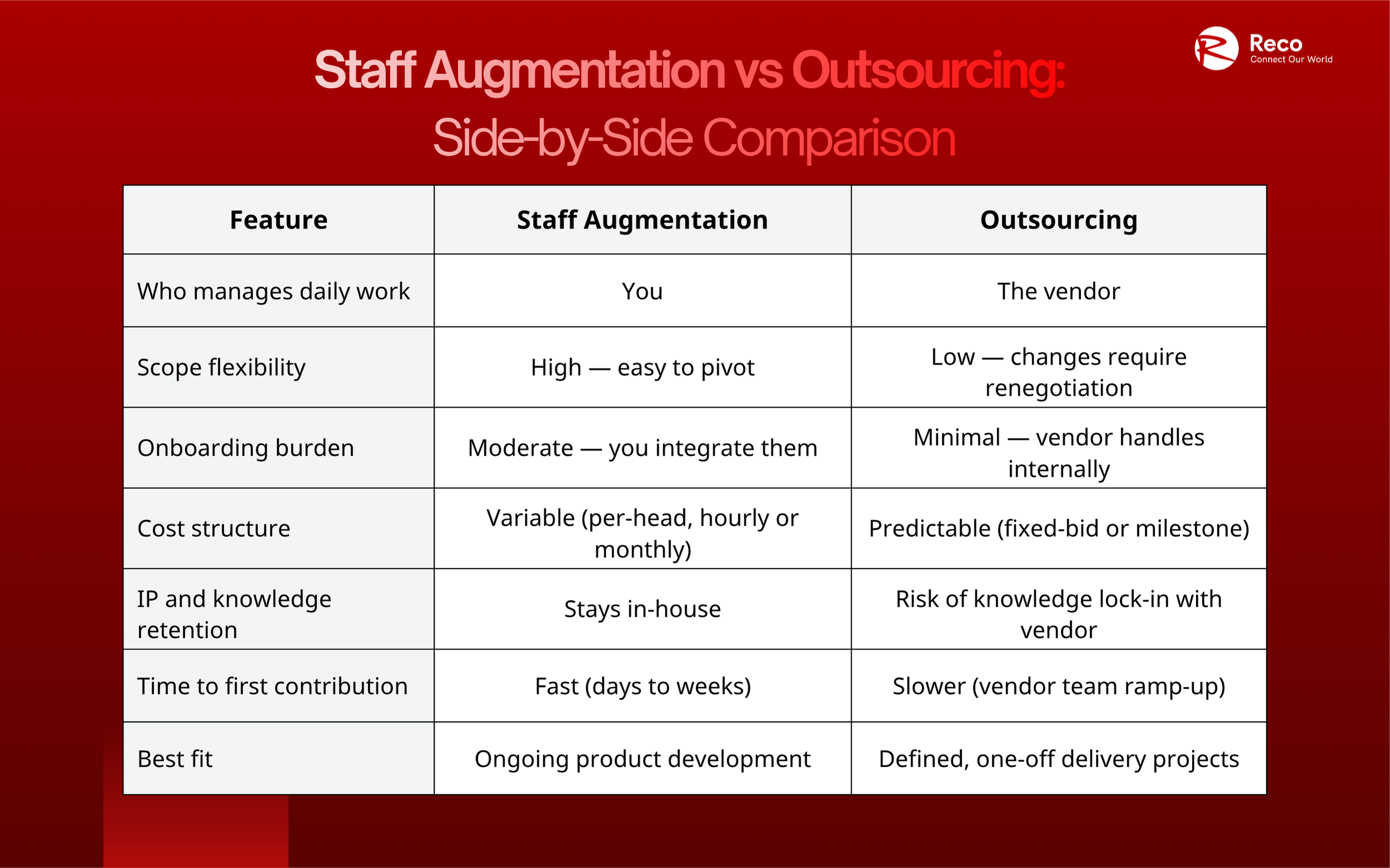
| Feature | Staff Augmentation | Outsourcing |
| Who manages daily work | You | The Vietnam vendor |
| Scope flexibility | High — pivot without renegotiating | Low — changes require new agreements |
| Onboarding | Into your tools and culture | Vendor handles internally |
| Cost structure | Variable per-head (hourly or monthly) | Fixed-bid or milestone |
| IP and knowledge retention | Stays in your organisation | Risk of lock-in with vendor |
| Time to first contribution | Fast — days to weeks | Slower — vendor team ramp-up |
| Control over who’s on your team | High — you interview and approve | Low — vendor assigns resources |
| Best fit | Ongoing product development | Defined, one-off delivery |
5. The 5-Question Framework: Which Model Fits Your Vietnam Hiring Decision?
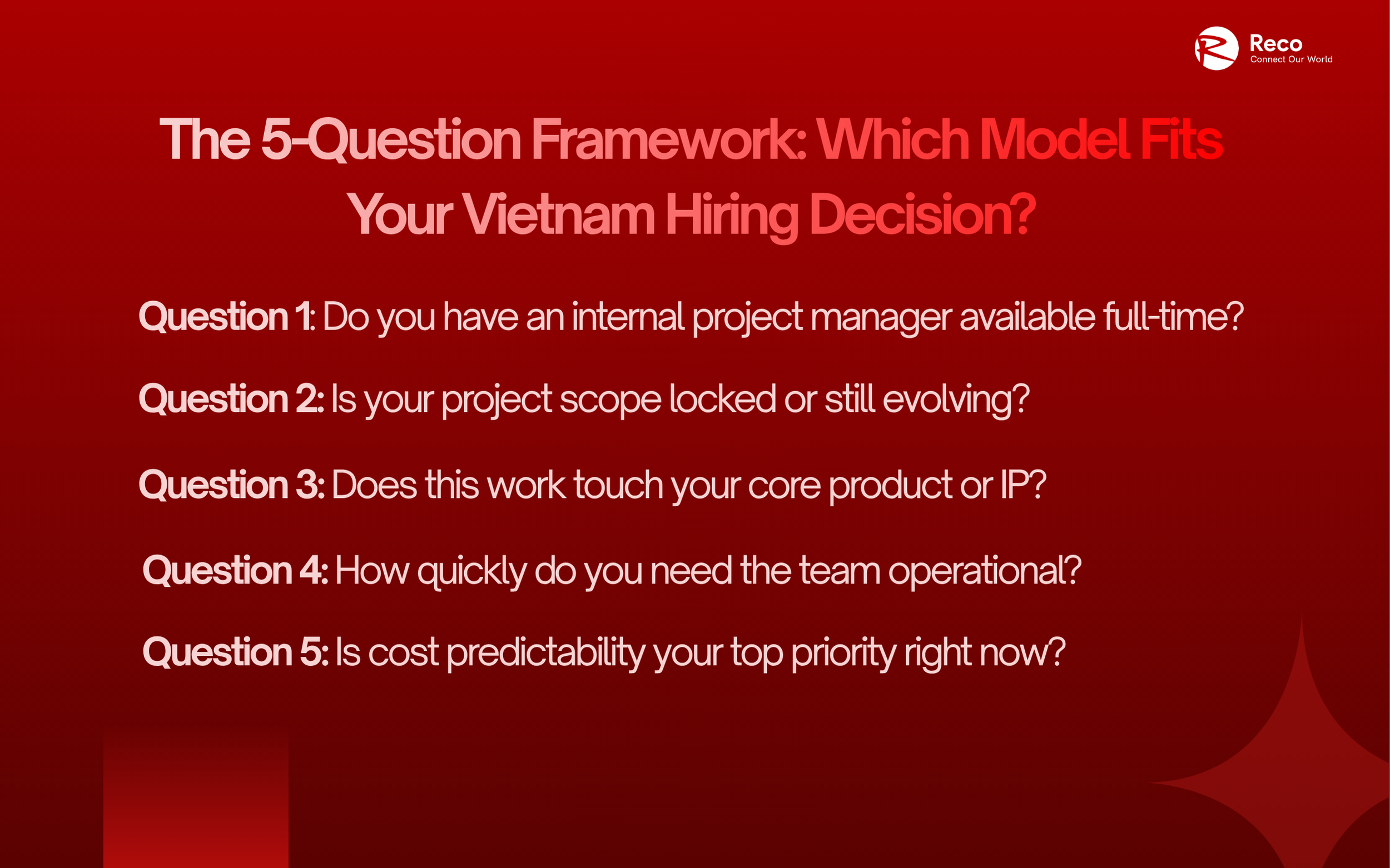
Rather than relying on a generic “it depends” answer, use this decision flow to qualify which model fits your specific situation right now.
Question 1: Do you have an internal project manager available full-time?
- Yes → Staff augmentation is viable. Your PM can absorb the management overhead of integrating a Vietnam-based engineer or team.
- No → Lean toward outsourcing. Without a dedicated PM, managing augmented staff across timezones will stretch your leadership team and create communication bottlenecks.
Question 2: Is your project scope locked or still evolving?
- Locked (detailed specs, fixed deliverables) → Outsourcing works well here. Fixed-bid pricing with a Vietnam vendor is predictable when requirements are stable.
- Evolving (Agile, iterative product development) → Staff augmentation. Outsourcing with fluid scope in Vietnam — as anywhere — is a reliable recipe for expensive change orders and misaligned expectations.
Question 3: Does this work touch your core product or IP?
- Yes (core product logic, proprietary algorithms, customer data architecture) → Staff augmentation. Keep strategic knowledge inside your organisation. A Vietnam-based engineer working directly under your management retains that knowledge where it belongs.
- No (non-core: QA regression, data migration, infrastructure setup) → Outsourcing is lower risk. Vendor dependency on peripheral work is manageable, and the fixed-scope model suits these workstreams well.
Question 4: How quickly do you need the team operational?
- Within 2–4 weeks → Staff augmentation through a provider with a pre-vetted Vietnam talent pool. With the right partner, you can interview shortlisted candidates within days and have engineers contributing within two to three weeks.
- Timeline is flexible (6–12 weeks acceptable) → Outsourcing can work. Vietnam vendor teams need time to form, brief, and ramp — but the investment is worthwhile for well-scoped projects.
Question 5: Is cost predictability your top priority right now?
- Yes (board-approved fixed budget) → Outsourcing offers clearer upfront cost visibility, as long as scope doesn’t drift.
- No (flexible budget tied to team output) → Staff augmentation. Pay for the talent you actually use, scale up when a sprint demands it, reduce when it doesn’t.
Reading your result:
- Mostly first answers → Staff augmentation in Vietnam is likely your better fit.
- Mostly second answers → Vietnam outsourcing aligns with your current situation.
- Mixed answers → A hybrid approach may serve you best: staff augmentation for your core product team, outsourcing for defined peripheral workstreams (more on this below).
6. How Staff Augmentation Actually Works With a Vietnam-Based Team
For Australian companies new to hiring in Vietnam, the practical mechanics matter as much as the model decision. Here’s what working with Vietnam-based augmented engineers typically looks like day-to-day.
Timezone and working hours: Vietnam’s UTC+7 gives Australian eastern states a 3-hour morning overlap (7am–10am AEST maps to 10am–1pm AEPM). Most Australian teams run their standups and design reviews in this window, then transition to async work for the rest of the day. It requires some schedule discipline but is very workable — more so than teams in India or Eastern Europe.
Communication and tooling: Vietnam engineers who have worked with international teams are generally comfortable with English-language technical communication — pull request reviews, Jira tickets, Confluence docs, Slack threads. Spoken English varies more than written; factor this into how you structure handoffs and documentation.
Read more: Top 16 Trusted IT Staffing Agencies in Vietnam for Top-notch Tech Talent in 2026Onboarding: Plan for two to three weeks of meaningful onboarding time. Vietnam-based augmented engineers are fast learners but need context — your codebase conventions, product decisions, and team norms. The investment pays back quickly once they’re up to speed.
Compliance and legal structure: This is where many Australian companies hit unexpected friction. If you don’t have a legal entity in Vietnam, you cannot directly employ Vietnamese engineers — employment contracts, tax withholding, social insurance, and labour law compliance all fall under Vietnamese jurisdiction.
The standard solution is an Employer of Record (EOR) arrangement. Under EOR, a locally registered Vietnamese company acts as the legal employer of your engineers, handling all HR administration, payroll processing, and statutory compliance on your behalf. You maintain full day-to-day management of the work. The result: you get the control of staff augmentation without the overhead of establishing a Vietnamese legal entity.
7. Philippines vs Vietnam: Why the Market Choice Matters

Most Australian companies evaluating offshore IT talent compare Vietnam against the Philippines. Both are credible markets, but they suit different needs.
| Philippines (UTC+8) | Vietnam (UTC+7) | |
| Morning overlap with AEST | 2 hours | 3 hours |
| Tech industry roots | BPO, managed support, helpdesk | Software engineering, product dev |
| Engineering talent depth | Strong in support and process roles | Stronger for product and platform engineering |
| English proficiency | Higher (spoken and written) | Sufficient for technical collaboration |
| IT talent pool | ~200,000 | 330,000+ |
| Cost trajectory | Increasing rapidly | Competitive for mid-to-senior engineering |
For Australian companies specifically looking to build or scale product engineering teams — frontend, backend, mobile, cloud, data — Vietnam’s talent depth in these disciplines is a genuine advantage. The Philippines remains strong for roles where high English fluency and client communication are the primary requirements.
The broader point: if your goal is to hire IT developers in Vietnam specifically, the staff augmentation model tends to unlock that talent more directly than outsourcing — because you’re selecting individuals based on your own technical criteria, not accepting whoever the vendor assigns to your project.
8. A Note on Hybrid Models
For most Australian tech companies at growth stage, the staff augmentation vs outsourcing debate doesn’t have to be a binary choice — it can be a deliberate combination of both.
A pattern that works well in the Vietnam context:
- Core product team → Staff augmentation. Your frontend engineers, backend developers, and senior architects work directly under your management. IP stays in-house. Knowledge accumulates in your organisation.
- Defined peripheral workstreams → Outsource. QA automation suites, infrastructure migrations, data pipeline builds, or security audit work are well-suited to Vietnam’s outsourcing vendors when the scope is stable and the requirements are detailed.
The key is being deliberate about which work goes where — rather than defaulting to one model for everything because it’s simpler to administer.
9. Which Should You Choose?
Choose staff augmentation in Vietnam if:
- You have an internal PM available to manage an integrated remote team
- Your product is in active development with evolving requirements
- The work touches your core platform, codebase, or proprietary systems
- You want engineers who accumulate your product knowledge over time
- Speed of hire matters — you need people contributing within weeks, not months
Choose Vietnam outsourcing if:
- Your project has a detailed, stable specification and a fixed delivery timeline
- You want to fully offload delivery management for a non-core function
- You have limited internal bandwidth to manage a distributed team
- Budget predictability is a hard board-level requirement
Consider a hybrid approach if:
- You’re scaling a product team while managing defined parallel workstreams
- Different parts of your IT portfolio have genuinely different risk and control profiles
Getting Started: What to Look for in a Vietnam IT Partner
Whether you go staff augmentation or outsourcing, your outcomes depend heavily on the partner you choose. A few things worth evaluating:
Talent access: How large is their candidate pool? How fast can they present shortlisted profiles? A provider with a pre-built database of vetted Vietnamese IT professionals will move significantly faster than one that recruits from scratch for each request.
Compliance capability: Can they act as your EOR in Vietnam? This removes the single biggest legal and administrative barrier for Australian companies hiring without a local entity.
Transparency on fit: Does the provider push to fill headcount quickly, or do they take time to understand your tech stack, team culture, and long-term direction? The difference matters significantly for retention and performance.
Track record with Australian clients: Vietnam is a well-established market for APAC tech hiring. A partner with direct experience placing engineers for Australian companies will understand the timezone dynamics, communication expectations, and onboarding requirements that matter to your team.

Looking to hire reliable and highly qualified tech professionals in Vietnam? Reach out to Reco Manpower today for tailored recruitment solutions that match your business needs.
FAQs
Staff augmentation means you hire individual Vietnamese engineers who work directly under your management as an extension of your existing team. Outsourcing means you hand a project or function to a Vietnam-based vendor who manages delivery end-to-end. The core difference is control: with staff augmentation, you run the team; with outsourcing, the vendor does. Reco specialises in staff augmentation and dedicated team models — specifically because most of our clients want that direct control over who’s on their team and how the work gets done.
Staff augmentation works well across most software engineering disciplines: frontend and backend developers, mobile engineers, DevOps and cloud specialists, QA automation engineers, data engineers, and increasingly AI/ML roles. Reco’s database covers 330,000+ IT professionals across these categories, with a particular depth in product engineering roles that align with what most Australian tech companies are building.
Yes — through an Employer of Record (EOR) arrangement. An EOR provider acts as the legal employer of your Vietnam-based engineers, handling employment contracts, payroll, tax, and social insurance compliance under Vietnamese law, while you keep full day-to-day management of the work. Reco offers EOR as a built-in option, which means you can hire compliantly in Vietnam from day one without establishing a local entity.