1. What Is BOT Transfer Phase Failure?

BOT transfer phase failure occurs when the engineering team a company funded for 24 months begins resigning — individually or in clusters — in the weeks surrounding the legal handover to the parent entity. The client inherits the org chart but loses the institutional knowledge.
The Transfer phase is when the BOT partner hands over the legal entity, employment contracts, IP, and physical assets to the client’s parent organization. On paper, it is an administrative event. In practice, it is the highest-risk moment in the GCC lifecycle.
Industry practitioners document attrition of 5–15% during the transfer window under standard BOT arrangements (eorHQ, 2026). Under poorly structured engagements, that figure is higher — concentrated among the senior engineers with the deepest codebase context and the strongest market optionality.
The structural reason: most BOT contracts are negotiated as outsourcing agreements, not capability-transfer agreements. The vendor’s incentive is to maximize operational margin across 24 months. The client’s interest is a smooth handover at month 24. These objectives do not align, and no standard contract clause resolves the gap.
2. 7 Root Causes of BOT Transfer Phase Failure
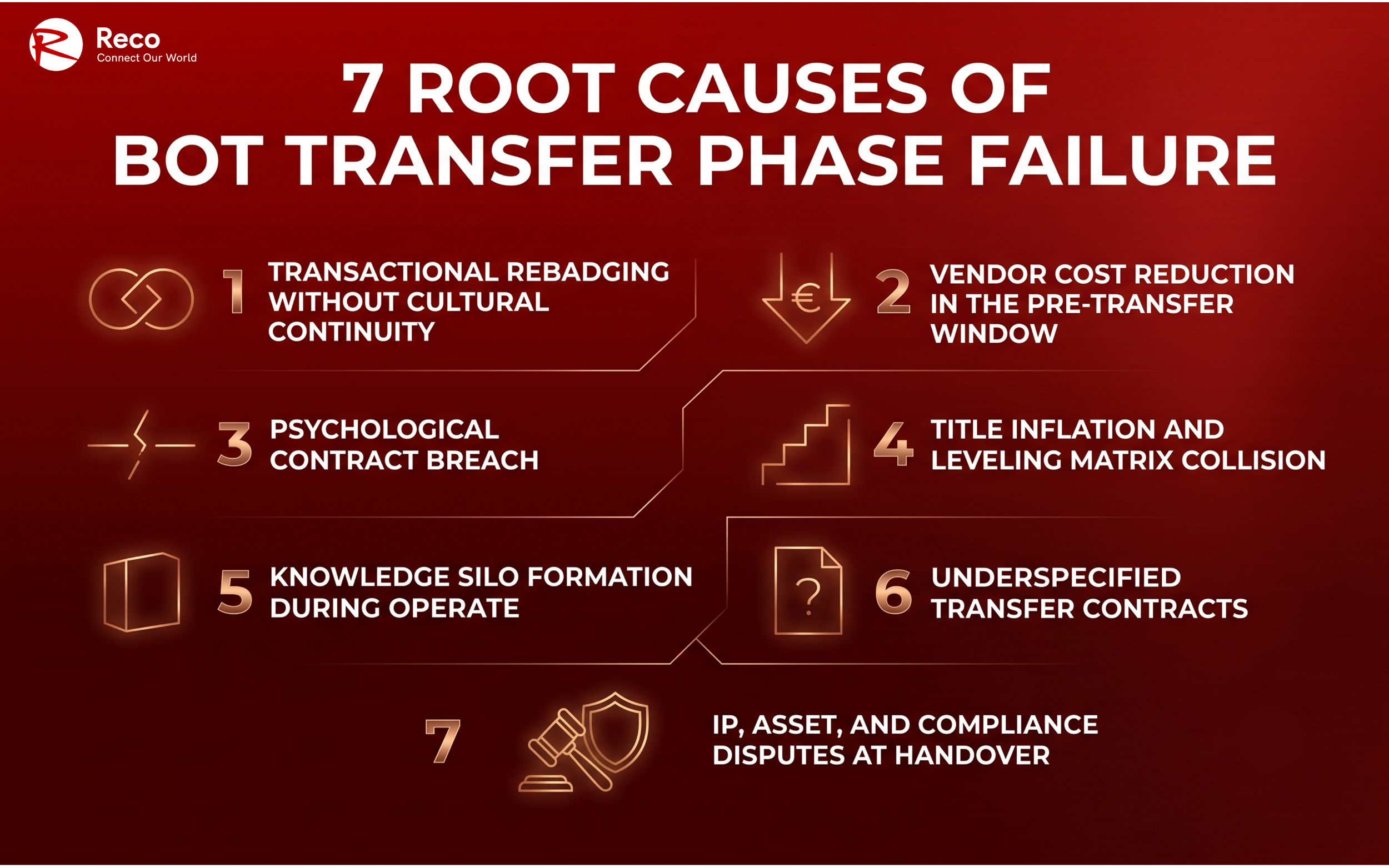
1. Transactional Rebadging Without Cultural Continuity
The most common failure mode: the vendor terminates engineer contracts on day 730 and issues new contracts under the client entity on day 731. No transition period, no HR continuity, no advance communication about what the new employment structure looks like.
Engineers experience this as being sold between two companies rather than promoted into a new structure. The rational response is to activate market options — they have been headhunter-visible throughout the project. ANSR (2026) identifies cultural misalignment carried over from the Operate phase as the single most common BOT transfer failure point. The gap forms during Operate. It becomes visible at Transfer.
2. Vendor Cost Reduction in the Pre-Transfer Window
BOT vendors earn Operational Margin — the difference between client billing and team operating cost — across the Operate phase. That revenue ends at Transfer. In the 45–60 days before contract expiry, vendors with no structural incentive for transfer quality begin predictable cost reduction: HR headcount is reassigned, engagement activities stop, engineer grievances go unaddressed because “this team is leaving anyway.”
The 90-day window surrounding Transfer — roughly 45 days before and 45 days after the legal handover date — is the highest attrition risk period in the BOT lifecycle (InductusGCC, 2026). Engineers begin monitoring organizational signals and fielding competitive offers well before the legal event occurs.
3. Psychological Contract Breach
High-performance engineers do not build primary loyalty to a legal employer. They build loyalty to the working environment — team structure, management relationships, engineering culture, and implicit career expectations. Organizational psychology calls this the Psychological Contract: the unwritten set of mutual obligations between employer and employee that operates alongside the formal employment agreement (Rousseau, 1989).
Research published in the European Journal of Information Systems (2013) found that in IT outsourcing contexts, formal legal governance does not predict whether engineers stay post-transfer. The quality of the implicit working relationship does. When Transfer is managed as a legal formality with no continuity maintained, engineers experience a breach of that contract and move to market immediately.
4. Title Inflation and Leveling Matrix Collision
Vendors inflate titles to retain engineers during the Operate phase — a 4-year engineer becomes a Tech Lead, a capable mid-level developer becomes a Principal. These titles are coherent within the vendor environment but misaligned with global corporate leveling frameworks.
When the client’s parent entity applies its standard leveling matrix at Transfer, automatic downgrade is the structural outcome. The compensation may be equivalent, but the title regression is experienced as demotion. And demotion triggers resignation — particularly among the engineers whose inflated titles signaled seniority to the external market.
5. Knowledge Silo Formation During Operate
A less visible but equally damaging failure: the Vietnam team builds deep product context that is never systematically transferred to the client’s parent organization. Throughout the Operate phase, the vendor manages the team as a delivery unit, not as a capability being handed over. Documentation is sparse. Architecture decisions live in individual engineers’ heads. The client’s home office has limited direct exposure to the team’s working methods.
When Transfer occurs, the client discovers they have ownership of a team whose institutional knowledge is inaccessible without the vendor’s operational context. Technogen India (2026) documents this as a consistent post-transfer outcome when vendors focus on delivery metrics during Operate rather than capability maturity.
6. Underspecified Transfer Contracts
Everest Group research identifies unclear transition planning as the root cause in 42% of BOT failures — not execution failures at Transfer, but contractual gaps written into the original agreement. The most common underspecified elements: IP assignment mechanism, title mapping protocol, asset valuation methodology, and post-transfer HR support obligations.
When these are not contractually defined at engagement start, they become negotiation points at month 24 — under time pressure, with misaligned incentives, and with the vendor holding operational leverage the client did not anticipate.
7. IP, Asset, and Compliance Disputes at Handover
Transfer phase failures are not always people-related. Legal and financial disputes are a second class of failure that delays or destabilizes the handover itself.
Source code custody is the most acute risk. Vendors who did not implement real-time IP assignment may use repository access as leverage during final billing negotiations — a position the client cannot counter quickly without operational disruption.
Hardware valuation becomes a dispute when no pre-agreed book value exists at contract inception. Assets that require independent audit before Transfer create delays that extend the governance gap and prolong engineer uncertainty.
3. Vietnam-Specific Transfer Risks in 2026
Vietnam BOT engagements carry regulatory risks that amplify standard transfer failures if not addressed at contract design.
- PIT restructuring under Law 109/2025/QH15 (effective 1 July 2026) changes the Gross-to-Net calculation for senior engineers. The progressive tax schedule is reduced from seven to five brackets, with the 35% ceiling raised from VND 80 million to VND 100 million monthly assessable income. For engineers in the USD 3,500–6,000+ gross range, a poorly structured compensation package at Transfer can result in lower net take-home pay under the new entity — a direct and preventable attrition trigger.
- Social insurance and PIT settlement obligations must be fully cleared on the vendor side before Transfer is complete. Unresolved cumulative PIT from the Operate phase becomes compliance inheritance risk for the client’s new entity — a liability that surfaces during the first statutory audit.
- Permanent Establishment exposure under Decree 320/2025/ND-CP applies when the client begins exercising operational direction over the Vietnam team before the legal transfer is finalized. BOT arrangements with overlapping control periods — common when transfers are delayed or contested — create retrospective CIT liability that the client’s CFO did not budget for.
Key Questions C-Suite Should Ask Before Signing a BOT Contract
The following questions separate vendors who have designed for Transfer from those managing it as an afterthought.
“On Day 1 of the Build phase, which tooling and systems will engineers use — yours or ours?” Vendor-owned infrastructure creates an operational layer that must be unwound at Transfer, extending the cultural gap and the attrition risk window.
“What is the contractual mechanism for IP assignment during the Operate phase?” End-of-engagement IP transfer leaves repository access as potential leverage in final billing negotiations.
“What is the pre-agreed buyout value for hardware and office assets at month 24?” Unspecified asset valuation becomes a negotiation point at handover — under time pressure and with misaligned incentives.
Reco Manpower partners with businesses across Vietnam and the region to build structured, scalable HR practices — from recruitment through performance management. Connect with our team to learn more.“What does your HR function’s involvement look like in the 90 days after Transfer?” Post-transfer HR continuity covers the highest attrition risk period. A vendor who exits at signature transfers that risk entirely to the client.
“How have you handled title and leveling continuity in previous BOT transfers?” Vendors with genuine transfer experience maintain documented Title Mapping frameworks. Vague answers here typically surface as leveling disputes at month 24.
5. How Reco Manpower Structures BOT Engagements to Eliminate Transfer-Shock
The seven failure modes above are not inevitable. They are the product of BOT architectures designed for vendor margin, not client continuity. Reco’s approach is built around one constraint: the Transfer event at month 24 must be a legal formality, not a cultural disruption.
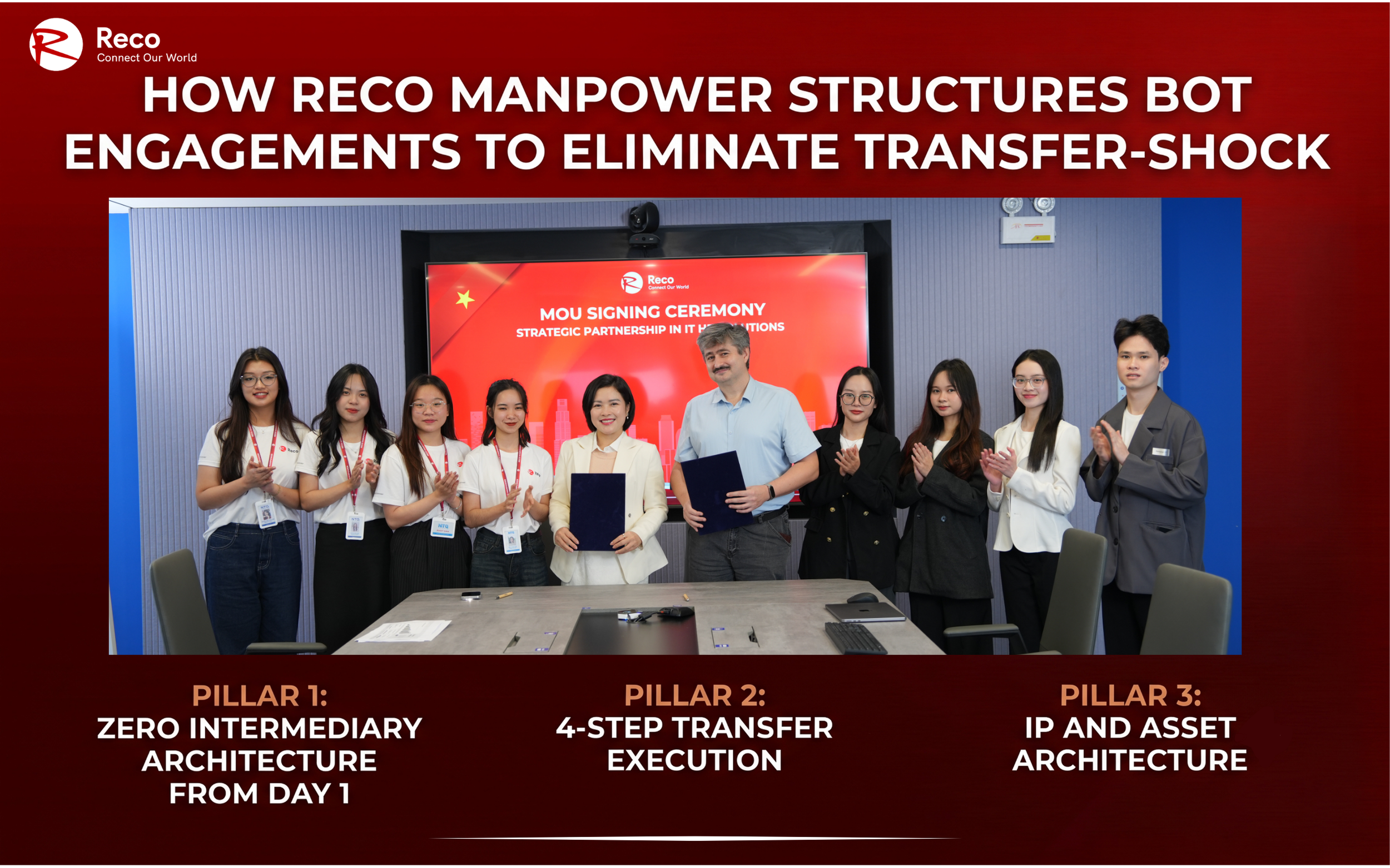
Pillar 1: Zero Intermediary Architecture from Day 1
From week one of the Build phase, Reco engineers operate exclusively inside the client’s technical ecosystem — client Jira, client GitHub, client CI/CD, client Slack. No Reco-branded operational layer exists at any point in the engagement.
The consequence is structural: there is nothing to dismantle at Transfer. The environment engineers work in on day 730 is identical to day 1 — because it was always the client’s environment. When the legal entity changes at month 24, nothing changes in the working day. The Psychological Contract is not breached. Transfer-Shock has no conditions to form.
Pillar 2: 4-Step Transfer Execution
| Step | What Reco Does |
| 1. Legal & regulatory clearance | Pre-clears PIT (Law 109/2025/QH15), social insurance, and vendor-side contract terminations before the Transfer date. Client entity inherits zero compliance liability |
| 2. Title Mapping | Negotiates explicit equivalences between vendor title, client leveling grade, and compensation band before Transfer contracts are issued. Engineers know their position in the new structure before they sign — not after |
| 3. Compensation continuity | Structures Gross-to-Net packages under the new PIT schedule to maintain engineer take-home pay within the client’s gross budget ceiling. Benefit enrollment in parent entity systems activated on Day 1 of new contracts |
| 4. Post-transfer continuity support | Reco HR remains embedded after the Transfer date — resolving compensation anomalies, managing edge cases, and maintaining management continuity until the client’s Vietnam entity reaches full operational independence |
Pillar 3: IP and Asset Architecture
| Mechanism | How It Works |
| Real-time IP assignment | Every code commit routes IP ownership directly to the client’s parent entity from day one. No intermediate custody in Reco’s systems. No repository leverage at the Transfer date |
| Pre-fixed asset buyout | Hardware and office infrastructure structured under Shadow Lease with Pre-Fixed Buyout Value locked at contract inception. At month 24, the CFO executes one predetermined financial transaction — no asset audit, no surprise tax liability, no PE exposure under Decree 320/2025/ND-CP |
Outcome: Post-transfer retention above 95%. A compliance-clean legal entity. A Vietnam GCC that operates as a fully client-owned capability from day one of ownership — not from the day the client finishes rebuilding what a failed Transfer destroyed.
Looking to hire reliable and highly qualified tech professionals in Vietnam? Reach out to Reco Manpower today for tailored recruitment solutions that match your business needs.
FAQs
Cultural discontinuity at the moment of legal handover. When engineers experience an abrupt change in employment entity — without advance communication, management continuity, or compensation clarity — they activate market options that have been available throughout the engagement. This is compounded when vendors reduce operational investment in the pre-Transfer window as their engagement revenue ends.
Under standard BOT arrangements, industry practitioners document attrition of 5–15% during the transfer window. Under poorly governed transfers — where no retention architecture was built during the Operate phase — attrition can exceed 20%, concentrated among senior engineers with the highest institutional knowledge and the strongest market optionality.
Transfer-Shock — the attrition spike caused by abrupt ownership change — can be structurally eliminated by building the client’s operational environment from Day 1 of the Build phase. When engineers have operated inside the client’s tooling, management cadence, and engineering culture for 24 months, the legal Transfer event changes their employment contract. It does not change their working day. There is no discontinuity to trigger attrition.