

The Growth Crunch: A 2026 Reality Check
Vietnam offshore hiring is running hot: quality IT hires take 45–60 days to close, against a market producing only 55,000–60,000 IT graduates a year for over 500,000 open technical roles. In this environment, comparing vendors on bill-rate alone misses the real cost driver — the administrative and legal liability sitting underneath the price.
Choosing between an employer of record vs staffing agency model isn’t an HR decision. It’s a financial architecture decision, and the answer depends on time horizon, cost structure, and who legally carries the risk.
Not sure which model fits your current headcount plan? Talk to Reco's workforce structuring team →1. Structural Frameworks: The Core Distinction
Employer of Record (EOR): Your Local Regulatory Shield
The client retains 100% control of the engineer’s work — technical direction, IP, performance. The EOR is the legal employer on paper, absorbing contracts, insurance, and payroll compliance.
Staffing Agency: The Variable Talent Pulley
Engineers stay on the agency’s own headcount and are deployed into the client’s pipeline for a defined window — built for short-cycle capacity, not permanent roles.
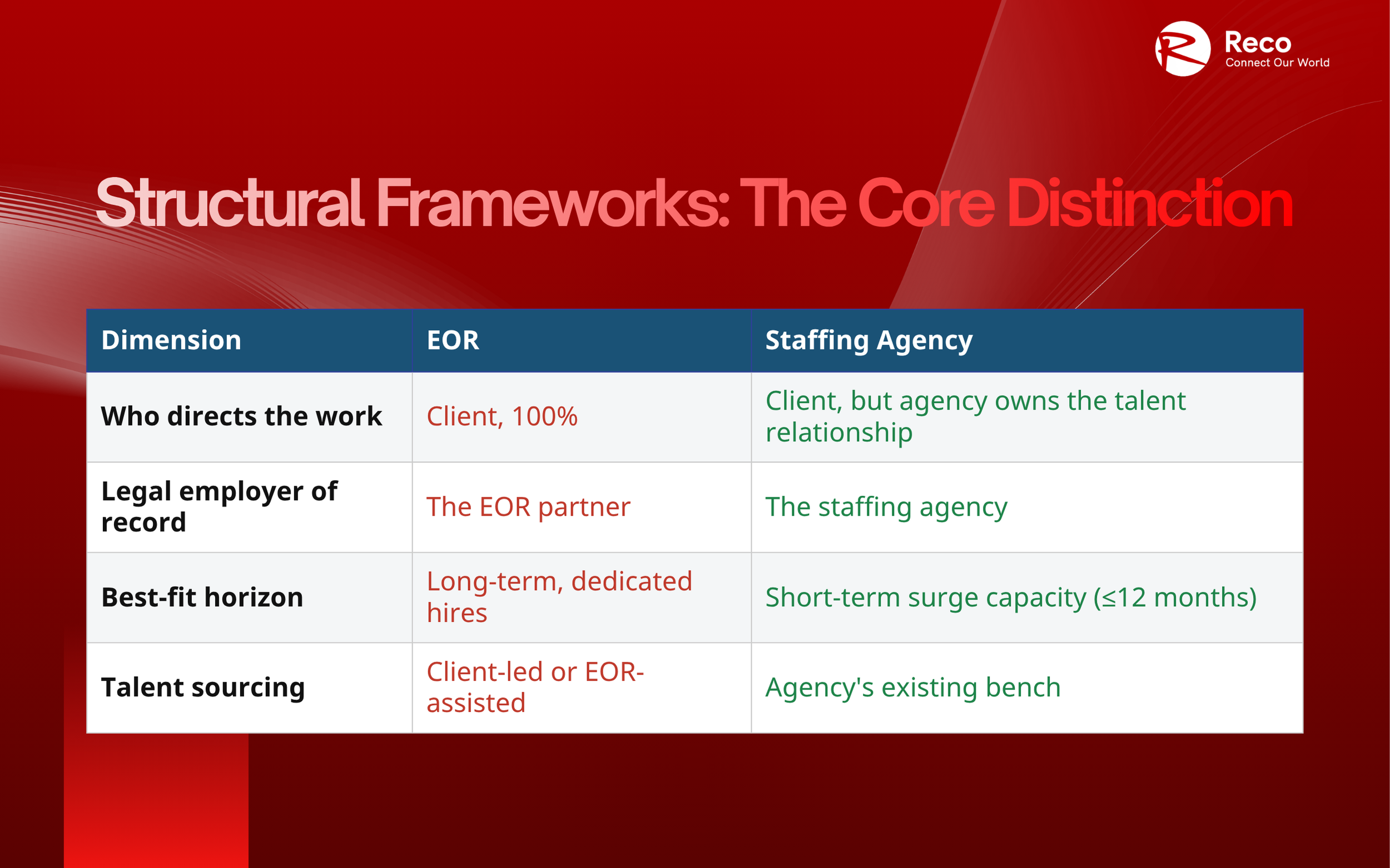
| Dimension | EOR | Staffing Agency |
| Who directs the work | Client, 100% | Client, but agency owns the talent relationship |
| Legal employer of record | The EOR partner | The staffing agency |
| Best-fit horizon | Long-term, dedicated hires | Short-term surge capacity (≤12 months) |
| Talent sourcing | Client-led or EOR-assisted | Agency’s existing bench |
2. The Cost Equation: Staffing Markups vs. EOR Flat Fees
Staffing agencies price on a markup model — 20–50% on top of salary. Efficient for engagements under 12 months, since it removes upfront recruitment cost and severance risk. The trap: when a “temporary” hire quietly runs 18–36 months, that markup compounds indefinitely, with no discount for tenure.
EOR pricing is a flat fee per head, per month, independent of salary. Past roughly 10–20 engineers, this becomes materially easier to forecast — a fixed line item instead of a moving percentage.
A Worked Example
Senior backend engineer, $2,000/month base, deployed 24 months:
| Staffing Agency (35% markup) | EOR (flat fee) | |
| Monthly cost to client | $2,700 | ~$2,300 (base + ~$300 flat fee) |
| Cost over 24 months | $64,800 | ~$55,200 |
| Cost as engagement extends | Scales with every raise/bonus | Stays flat |
| Cost if statutory contributions rise | Bill-rate typically renegotiated | Recalculated automatically |
That’s roughly $9,600/engineer over two years — before any mid-project raise or renegotiation. Across a 15-person team, the “temporary” staffing setup becomes the costlier long-term structure. (Illustrative figures; actual rates vary by provider.)
The 2026 trigger: Decree 293/2025/NĐ-CP, effective Jan 1, 2026, raised regional minimum wages ~7.2% (VND 250,000–350,000/month), which also lifts the floor for compulsory insurance contributions. Staffing agencies on old fixed bill-rates typically pass this on as a renegotiation; EOR fees absorb it automatically.
When auditing continuous technical deployment, comparing payroll services vs staffing agency cost structures early prevents this margin erosion from compounding.
Want a live comparison for your current headcount? Book your 20-minute cost audit with Reco →3. The Compliance Shield: Key Facts for 2026
PE risk: Paying Vietnamese developers directly via B2B/Payoneer to skip payroll tax carries real exposure. Under most DTAs, if personnel work in-country over 183 days within 12 months, the foreign entity risks a Permanent Establishment finding — triggering CIT on locally-attributed profit plus penalties.
No single “EOR” license — two valid structures exist:
- Labor outsourcing, under Article 52 of the 2019 Labor Code and Decree 145/2020/NĐ-CP, requires a Labor Outsourcing License and a VND 2 billion deposit. Capped at 12 months per worker.
- Direct local employment, where the Vietnam partner hires staff on its own entity and delivers a separate B2B service contract to the client — no third-party license required, but depends entirely on a valid local entity.
Many “EOR” providers actually run the second model. Either way, ask which structure applies and request the supporting documents — license and deposit confirmation, or entity and contract paperwork.
2026 update: Resolution 66.16/2026/NQ-CP, effective mid-April 2026, streamlined licensing to self-certification — meaning licenses are easier to obtain, so direct verification with local authorities matters more, not less.
To eliminate tax exposure, executives analyzing a PEO vs staffing agency alignment should confirm exactly which structure their partner operates under before signing.
Where EOR Isn’t the Right Answer
- Fixed fee, not elastic — doesn’t flex down during a vacancy the way a staffing markup would.
- Vendor concentration risk — one partner’s licensing or operational issue disrupts the whole team at once.
- Less built for rapid scale-down — staffing agencies flex faster in both directions.
These argue for structuring deliberately — an EOR core plus a staffing layer for volatility — not for avoiding EOR outright.
4. The Strategic Matrix
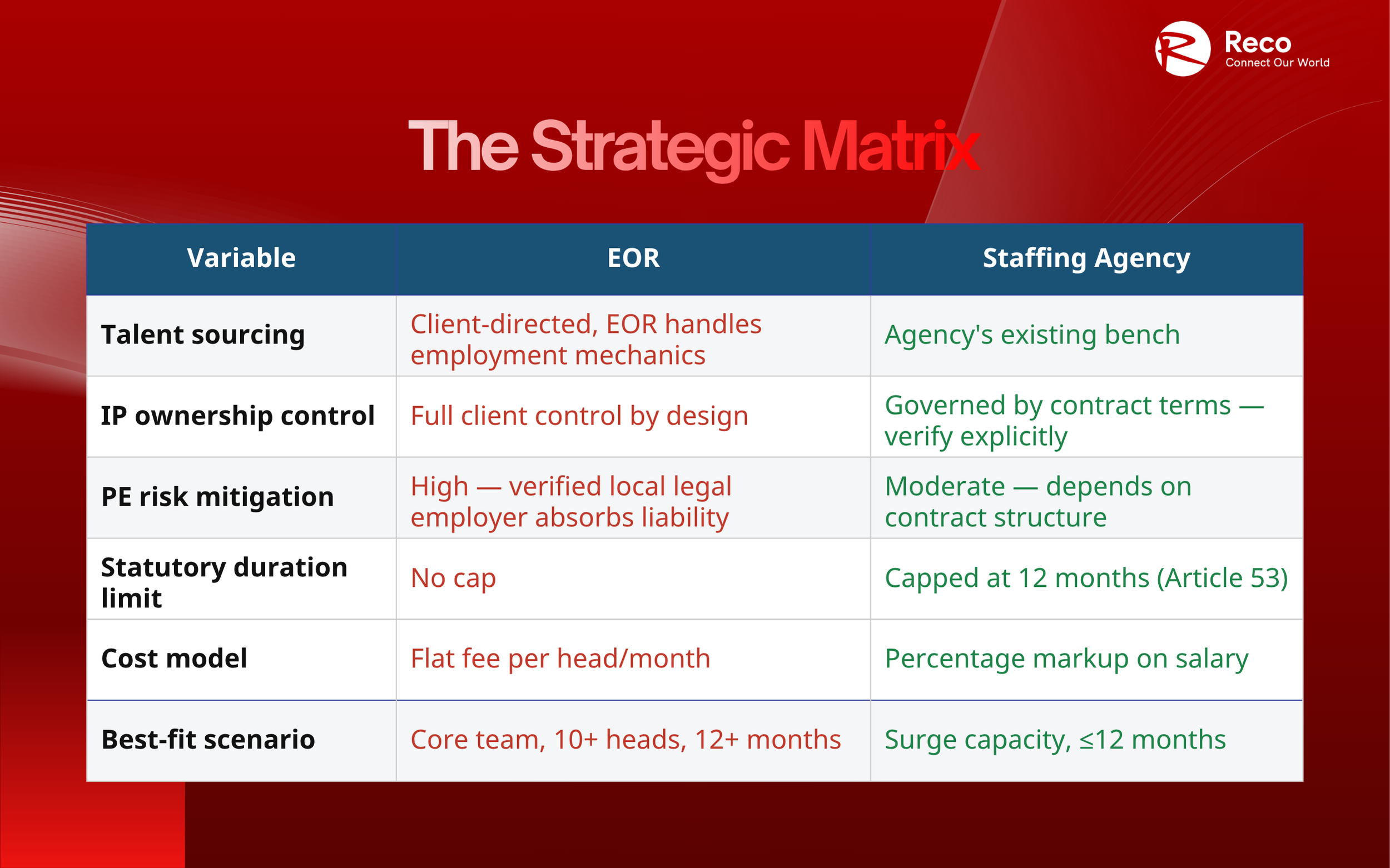
| Variable | EOR | Staffing Agency |
| Talent sourcing | Client-directed, EOR handles employment mechanics | Agency’s existing bench |
| IP ownership control | Full client control by design | Governed by contract terms — verify explicitly |
| PE risk mitigation | High — verified local legal employer absorbs liability | Moderate — depends on contract structure |
| Statutory duration limit | No cap | Capped at 12 months (Article 53) |
| Cost model | Flat fee per head/month | Percentage markup on salary |
| Best-fit scenario | Core team, 10+ heads, 12+ months | Surge capacity, ≤12 months |
Most scaling teams need both: an EOR-backed core for the permanent roadmap, and a staffing layer for short, defined surges.
Conclusion: Building a De-Risked Human Capital Architecture
The right call isn’t the cheaper bill rate — it’s matching the model to the time horizon and verifying your partner’s actual legal standing before wages and tax brackets shift again.

Looking to hire reliable and highly qualified tech professionals in Vietnam? Reach out to Reco Manpower today for tailored recruitment solutions that match your business needs.
FAQs
The main difference lies in operational direction and the time horizon. A staffing agency provides immediate, short-term surge capacity ($le$12 months) by leasing technical talent directly from its own bench pool. An Employer of Record (EOR) provides long-term employment infrastructure; you retain 100% control over the candidate selection, day-to-day workflow, and engineering culture, while the EOR partner handles local statutory payroll, compliance, and legal
No, Vietnamese labor law does not recognize the literal term “Employer of Record” or “PEO”. In practice, any compliant EOR or IT staff augmentation framework operating in Vietnam must execute transactions under the strict jurisdiction of a Labor Outsourcing License, governed by Article 52 of the Labor Code 2019.
Yes. Reco Manpower operates with full compliance under a valid Labor Outsourcing License, strictly meeting the conditional business metrics outlined in Article 52 of the Vietnam Labor Code.