1. What is an Employer of Record
When people search what is an employer of record, they usually expect a simple definition. Technically, an employer of record (EOR) is a third-party company that legally employs workers on behalf of another business. However, that explanation alone does not fully reflect why this model is becoming essential in global hiring.
The real challenge lies in complexity. Every country has different labor laws, tax systems, and compliance requirements. Setting up a legal entity just to hire one or two employees is often inefficient. An EOR removes that barrier by allowing companies to hire first while outsourcing the legal employment layer.
1.1. What does EOR stand for
EOR stands for Employer of Record, referring to the legal employer of a worker in a specific country. While your company manages the employee’s daily work, the EOR is responsible for contracts, payroll, taxes, and compliance.
1.2. What does EOR mean in practice
The EOR meaning becomes clearer when viewed operationally. Instead of building infrastructure first, companies can separate employment into two layers: the legal layer handled by the EOR, and the operational layer managed internally.

In practice, an EOR allows companies to:
- Hire globally without setting up a local entity
- Transfer compliance responsibility to a local expert
- Focus internal resources on business growth
If you are wondering what is an EOR, it is best understood as a model that removes friction from international hiring rather than just a service.
This is why many businesses searching for what is an EOR often end up adopting the employer of record model as a practical solution for global hiring.
Ensure 100% Payroll Compliance in Vietnam with Reco Manpower - Reco EOR1.3. How an EOR Company Works
An EOR company acts as the legal employer in the country where your employee is located, while your company retains full control over work and performance.
1.3.1. Hiring through an EOR
When a company identifies a candidate abroad, the EOR hires that individual under local law. This significantly reduces onboarding time.
Typical hiring flow:
- Candidate selected by your team
- EOR signs employment contract
- Employee onboarded locally
- Your team manages daily work
1.3.2. Payroll and compliance under an EOR
Managing payroll and compliance across different countries is often one of the most complex parts of global hiring. This is where an EOR company plays a critical role, acting as the legal employer and ensuring that all employment-related obligations are handled correctly under local regulations.
- What is included in EOR payroll
An EOR typically manages the entire payroll process, from salary calculation to payslip distribution and statutory deductions. This includes handling taxes, social insurance contributions, and any mandatory benefits required by local law.
By centralizing these responsibilities, companies can avoid setting up separate payroll systems in each country while still ensuring employees are paid accurately and on time.
- How EOR ensures compliance across markets
Compliance goes beyond payroll and is a core part of the EOR meaning in practice. Each country has its own labor regulations, covering employment contracts, termination policies, and employee benefits.
An EOR ensures that all these elements are aligned with local requirements, reducing the risk of legal issues that may arise when operating in unfamiliar markets. This allows businesses to expand internationally without needing deep legal expertise in every region.
To summarize, an EOR handles both payroll execution and compliance management in one integrated process. In practice, this usually covers:
- Payroll processing and payslips
- Tax filing and deductions
- Social insurance contributions
- Compliance with labor regulations
This is why many companies combine EOR with services like IT Headhunting in Vietnam to streamline both hiring and compliance in a single workflow.

1.4. Real-world scenario of using an EOR
Imagine you want to hire a developer in Vietnam but don’t have a local entity. Without an EOR, you would need months to set up operations. With a global employer of record, you can onboard that developer within days and start working immediately.
| Scenario | Without EOR | With EOR |
| Time to hire | 2–6 months | 1–2 weeks |
| Legal setup | Required | Not required |
| Compliance risk | High | Managed by EOR |
| Flexibility | Low | High |
This is why an EOR company is often used as a first step before long-term expansion.
2. Employer of Record Benefits
Understanding employer of record benefits requires looking beyond convenience and focusing on strategic value.
2.1. Key employer of record benefits
These benefits may seem straightforward, but their impact becomes much clearer when viewed in real business scenarios.
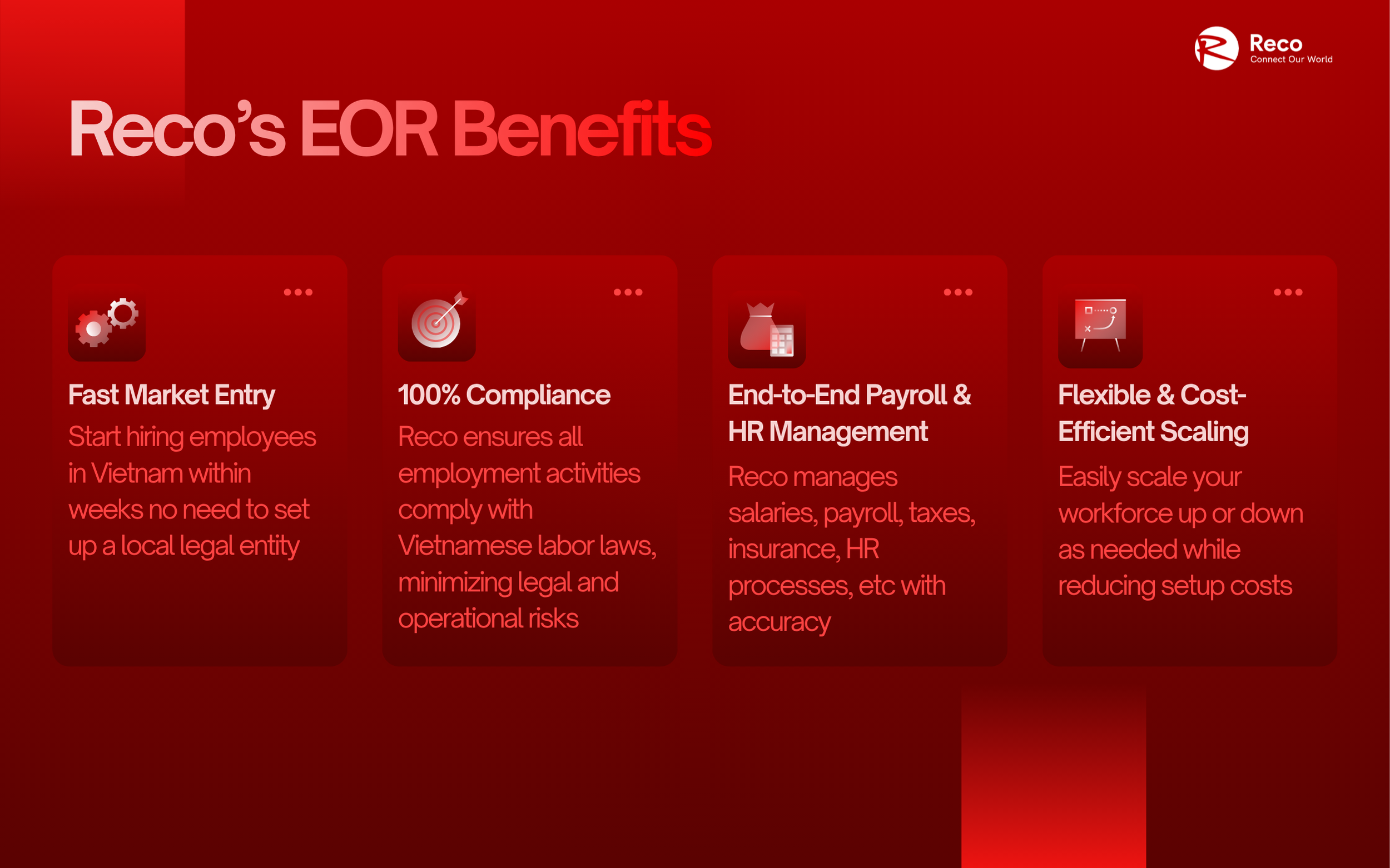
- Faster hiring across markets
One of the most immediate advantages is speed. Companies can hire talent in new markets within days instead of waiting months to complete legal setup. In competitive industries, this speed can directly influence business outcomes.
- Reduced compliance risk
Hiring in a foreign country involves navigating complex labor laws and tax systems. An EOR helps manage these requirements, reducing the likelihood of compliance errors and associated penalties.
- Flexible expansion strategy
Instead of committing to long-term infrastructure, companies can scale teams up or down depending on business needs. This flexibility makes it easier to test new markets or adjust strategies without significant financial risk.
- Simplified operations
In addition to the strategic benefits, there are also operational efficiencies. With an EOR handling payroll, contracts, and administrative tasks, internal teams can focus on core business activities rather than HR and compliance management.
2.2. Strategic impact of using an EOR
Beyond operations, these benefits directly impact how companies grow internationally.
| Factor | Impact with EOR |
| Speed | Faster market entry |
| Risk | Lower legal exposure |
| Cost | Reduced setup investment |
| Flexibility | Easier scaling |
For companies comparing models, it’s common to evaluate EOR alongside staff augmentation services depending on hiring goals and control level.
3. Global Employer of Record in Modern Hiring

The rise of the global employer of record model reflects broader changes in how companies operate. Talent is no longer limited by geography, and businesses increasingly look beyond their home markets to find the right people.
At the same time, speed and flexibility have become critical. Companies are expected to move quickly, adapt to new opportunities, and manage risk effectively. A global employer of record supports all of these objectives by enabling companies to hire internationally without being constrained by traditional expansion processes.
In this context, understanding the full EOR meaning helps companies rethink how they approach international workforce expansion.
4. When an EOR May Not Be the Right Fit
While understanding what is an employer of record highlights many advantages, it is also important to recognize situations where it may not be the best solution. For companies that already have a legal entity in a country or plan to build a large, long-term presence, managing employment internally may be more cost-effective.
In these cases, solutions like payroll outsourcing services or entity setup may be more appropriate.
5. How Reco Manpower Approaches EOR Differently
Most EOR companies focus primarily on compliance and payroll. At Reco Manpower, the approach combines EOR services with fast and effective talent acquisition.
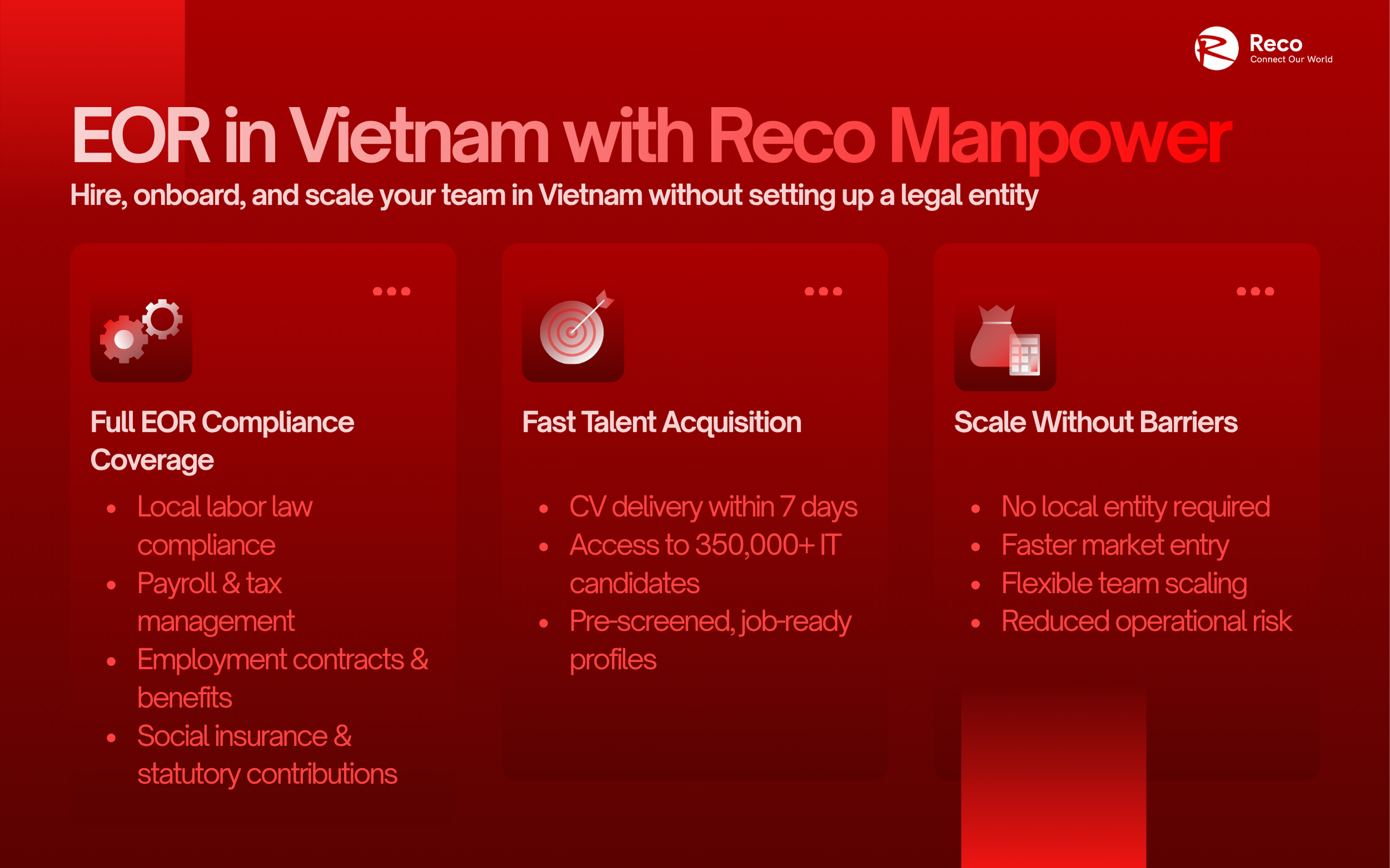
With Reco Manpower, companies get:
- Full EOR compliance support in Vietnam
- Access to a huge local IT talent pool (+350.000 candidates)
- Reco7 headhunt service delivering CVs within 7 days
This means businesses not only solve the legal employment challenge but also accelerate hiring at the same time. By integrating EOR + fast headhunting, Reco provides a more practical and execution-focused solution for companies entering Vietnam.
This makes Reco not just an EOR provider, but a hiring acceleration partner.
Conclusion
So, what is an employer of record? It is a solution that allows companies to hire internationally without setting up a legal entity, but its real value lies in enabling faster, more flexible expansion. By reducing compliance risks and simplifying operations, an EOR allows businesses to focus on growth while still accessing global talent. Understanding what is an employer of record helps companies make smarter decisions about how they build and scale teams across borders.

Looking to hire reliable and highly qualified tech professionals in Vietnam? Reach out to Reco Manpower today for tailored recruitment solutions that match your business needs.
FAQs
An employer of record is a third-party company that legally employs workers on behalf of another business while the business manages daily work.
An EOR (Employer of Record) and a PEO (Professional Employer Organization) are often confused, but they serve different purposes.
An EOR company becomes the legal employer of your workforce, which means you do not need a local entity to hire employees. In contrast, a PEO typically requires your company to already have a legal entity in the country and operates under a co-employment model.
If you are exploring what is an EOR, the key difference is that an EOR enables international hiring without infrastructure, while a PEO supports HR operations for existing entities.
Choosing between an EOR and setting up a legal entity depends on your expansion strategy. A global employer of record is ideal when speed, flexibility, and risk reduction are priorities. It allows companies to hire quickly, test new markets, and avoid long-term commitments.
On the other hand, if your company plans to build a large, permanent presence in a specific country, establishing an entity may be more cost-effective in the long run. Understanding what does EOR mean in this context helps businesses align hiring strategy with growth plans.
One of the biggest advantages of an EOR company is speed. In most cases, businesses can hire and onboard employees within 1–2 weeks, depending on the country and role. This is significantly faster compared to setting up a legal entity, which can take several months.
For companies that combine EOR with talent acquisition services, such as headhunting, the hiring timeline can be shortened even further. This is one of the key employer of record benefits that makes EOR a practical solution for fast-growing businesses.