
1. Contracts: written from day one
Vietnam requires employment contracts in writing before the engineer starts — including during probation (capped at 60 days for professional roles). Fixed-term contracts run up to 36 months, then convert to indefinite-term automatically.
The one thing to watch: some providers offer “consulting contracts” or “service agreements” as a simpler alternative. Since July 2025, this creates real exposure — Vietnam now treats any paid arrangement involving supervision and direction as employment, regardless of the contract label. If your engineer works set hours and reports to a manager, they’re an employee for compliance purposes.
2. Social insurance: what closed in 2025, what changed in 2026
The employer burden is 23.5% of gross salary. That number hasn’t changed. What changed is who it applies to.
Before July 2025, companies could use contractor-style arrangements to avoid social insurance. That loophole is closed. The 2024 Social Insurance Law now covers any arrangement with salary and management — retroactive penalties apply to arrangements that predate the law.
From January 2026, unemployment insurance is mandatory for contracts of one month or longer (previously three months). If your provider hasn’t updated their standard contracts for this, there’s a gap on the contract you’re about to sign.
One number worth knowing: social insurance contributions are capped at a monthly base of ~VND 46.8M (~USD 1,870). Salary above that cap is contribution-free — relevant for senior engineers.
Read more: Top 12 EOR Service Providers in Vietnam for 20263. IP ownership: the clause that’s often missing
Under Vietnamese IP law, work product belongs to the legal employer — the EOR entity — not your company, unless the contract explicitly assigns it to you.
A properly structured EOR agreement for IT includes:
- IP assignment at creation — not on payment or project completion
- Moral rights waiver — Vietnamese engineers retain authorship rights by default; these need to be waived
- Confidentiality scoped to source code, trade secrets, and proprietary systems
Ask for the actual clause language, not a summary. Global platforms include IP clauses, but they’re typically generic — if you have specific IP requirements, a provider with in-house legal in Vietnam can customize.
4. Tax: one operational detail that affects retention
The EOR withholds PIT monthly and handles annual finalization. Standard scope.
From January 2026, the personal deduction increased to VND 15.5M/month (up from VND 11M) and the dependent deduction to VND 6.2M/month. A senior developer at USD 2,000 gross faces roughly 7% effective PIT — lower than the headline brackets suggest.
Worth knowing: if the EOR gets PIT wrong, the penalty falls on the employee. Engineers who get hit with an unexpected tax bill at year-end remember whose contract they were on.
5. The checklist: 8 things to verify before signing
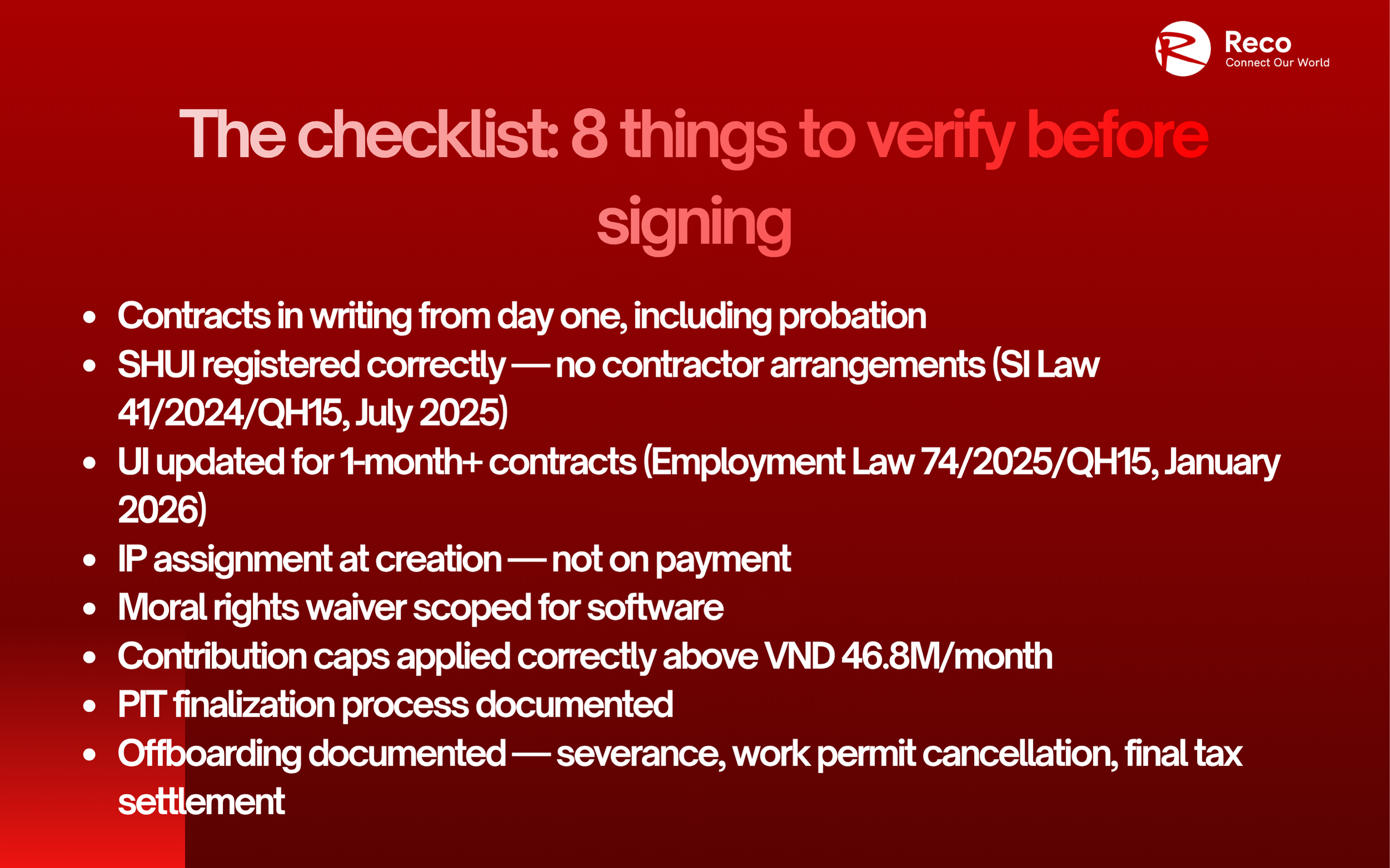
- Contracts in writing from day one, including probation
- SHUI registered correctly — no contractor arrangements (SI Law 41/2024/QH15, July 2025)
- UI updated for 1-month+ contracts (Employment Law 74/2025/QH15, January 2026)
- IP assignment at creation — not on payment
- Moral rights waiver scoped for software
- Contribution caps applied correctly above VND 46.8M/month
- PIT finalization process documented
- Offboarding documented — severance, work permit cancellation, final tax settlement

Looking to hire reliable and highly qualified tech professionals in Vietnam? Reach out to Reco Manpower today for tailored recruitment solutions that match your business needs.
FAQs
Yes — this is exactly what EOR is for. The EOR becomes the legal employer in Vietnam, handling contracts, SHUI, PIT, and (where needed) work permits. You direct the work. You don’t need a local entity, and there’s no minimum headcount requirement.
Since July 2025, significant. Vietnam’s updated social insurance law looks at the substance of the arrangement, not the label. If the engineer works set hours, reports to a manager, and receives regular payment — that’s employment. The exposure is retroactive: unpaid contributions plus daily interest, potentially going back to when the arrangement started.
Four to six weeks from submission. The EOR handles this as the sponsoring employer. Vietnamese nationals don’t need a work permit. Genuine short-term specialists working under 30 consecutive days (up to 90 cumulative days per year) are also exempt.