

1. What employing talent in Vietnam really costs, beyond salary
Salary is only the first layer of what you pay each month in Vietnam. The rest is set by law and applies to every employer in the country, so understanding the true Vietnam labor cost means accounting for all of it up front.
There are three layers to the monthly cost:
- Gross salary: what the engineer sees on their contract.
- Employer statutory contributions: mandatory amounts you owe on top of salary, 21.5% for Social, Health and Unemployment Insurance (SHUI), plus a 2% trade union fee. Fixed by law, not by any provider, and owed by every employer in Vietnam.
- Service or management fee: if you employ through an Employer of Record (EOR), this is the provider’s charge for handling the above. Pricing models vary, so this line is best confirmed in a quote.
The first two layers are the cost of employing anyone in Vietnam, with or without an EOR, and they are the focus of this guide. Whether an EOR is the right structure for your stage, and when to move to your own entity instead, is a separate decision covered in EOR solutions in Vietnam: cost, limits, and the 5 questions to ask.
Monthly employment cost = gross salary + 23.5% statutory contributions + 13th-month accrual (~8.3%)
The value of a transparent setup is simple: ask for the statutory contributions itemized line by line, and you see exactly what is salary and what is law. That clarity is what keeps employment predictable and fully costed, with no surprises at invoice time.
Read more: What is an Employer of Record? How EOR Works for Global Hiring2. The full employer statutory contributions in Vietnam (2026): what you actually owe
This is the part of the cost that’s set by law, not negotiation. As of 2026, an employer of a Vietnamese employee owes the following on top of gross salary:
| Contribution | Employer rate | Legal basis |
| Social Insurance (pension, sickness, maternity, occupational accident) | 17.5% | Law on Social Insurance No. 41/2024/QH15, effective 1 July 2025 |
| Health Insurance | 3.0% | Law on Social Insurance No. 41/2024/QH15 |
| Unemployment Insurance | 1.0% | Law on Employment No. 74/2025/QH15, effective 1 Jan 2026 |
| Subtotal (SHUI) | 21.5% | |
| Trade Union Fee | 2.0% | Trade Union Law No. 50/2024/QH15, effective 1 July 2025 |
| Total employer contributions | 23.5% | For Vietnamese employees |
A few points that catch foreign employers out:
The trade union fee is separate from SHUI, and easy to miss. The 2% trade union contribution is governed by the Trade Union Law No. 50/2024/QH15 (effective 1 July 2025), not the Social Insurance Law, and is mandatory even if your company has no internal union. Many quotes show “21.5% SHUI” and stop there. The honest number to budget against is 23.5% total. Distinguish clearly: 21.5% is SHUI; 23.5% is the full employer contribution.
Foreign employees pay less, not more. A foreign national on a work permit with a 12-month-plus contract is exempt from Unemployment Insurance. That drops the SHUI portion to 20.5%, and the total employer contribution to 22.5% (20.5% + 2% trade union). A common error is assuming foreigners are fully exempt; they’re not, and they pay SI and HI at the same rates as locals.
Contributions are capped, so high earners cost less in percentage terms. There are two separate ceilings, and conflating them is the most common costing mistake:
- SI, HI and the trade union fee are capped at 20× the statutory reference level = VND 46.8 million/month (about $1,800). Salary above this line attracts no further SI/HI/union contribution. (Note: the reference level rises to VND 2.53 million on 1 July 2026, lifting this cap to VND 50.6 million.)
- Unemployment Insurance is capped at 20× the Region I minimum wage = 20 × VND 5.31 million = VND 106.2 million/month (about $4,080), under Decree 293/2025/ND-CP, effective 1 January 2026. UI keeps scaling on full salary far longer than SI/HI does.
The practical effect: for a senior engineer earning above VND 46.8M, the effective rate is below 23.5%, because most of the salary sits above the SI/HI cap.
Unemployment Insurance now starts at 1-month contracts. Under the new Law on Employment No. 74/2025/QH15 (effective 1 January 2026), UI is mandatory for contracts of 1 full month or more, down from the previous 3-month threshold. Providers who haven’t updated their compliance may be under-contributing on short contracts, which becomes your liability.
Read more: Top 12 EOR Service Providers in Vietnam for 20263. What does the 13th-month salary mean for your budget?
The 13th-month salary is the single biggest cost most foreign employers don’t see coming, because it isn’t on the statutory table, and it isn’t strictly required by law.
It is, however, market law in Vietnamese IT. Roughly 90% of companies pay at least one month’s salary as a 13th-month bonus around Tet (Lunar New Year), and in tech and FDI-heavy sectors it’s often 1.5–3 months. You will not hire or keep a senior engineer without it.
To budget honestly, annualize it: divide one month’s salary by 12, and add ~8.3% to every monthly figure. For a senior developer at $2,000 gross, that’s an extra $167/month accrued toward the year-end bonus.
How this is handled matters for cash flow. Accruing the 13th month monthly keeps your run-rate accurate all year; leaving it to a single year-end charge turns your Q4 budget into a surprise. A good EOR accrues monthly and reports it on every invoice.
4. Real cost example: employing a senior IT engineer in Vietnam
Here is the full picture for a senior developer in Hanoi at $2,000/month gross (≈ VND 52 million). Note that this salary sits above the SI/HI cap of VND 46.8M, so those contributions are calculated on the capped base, not on full salary, which is why the effective rate is slightly below the headline 23.5%:
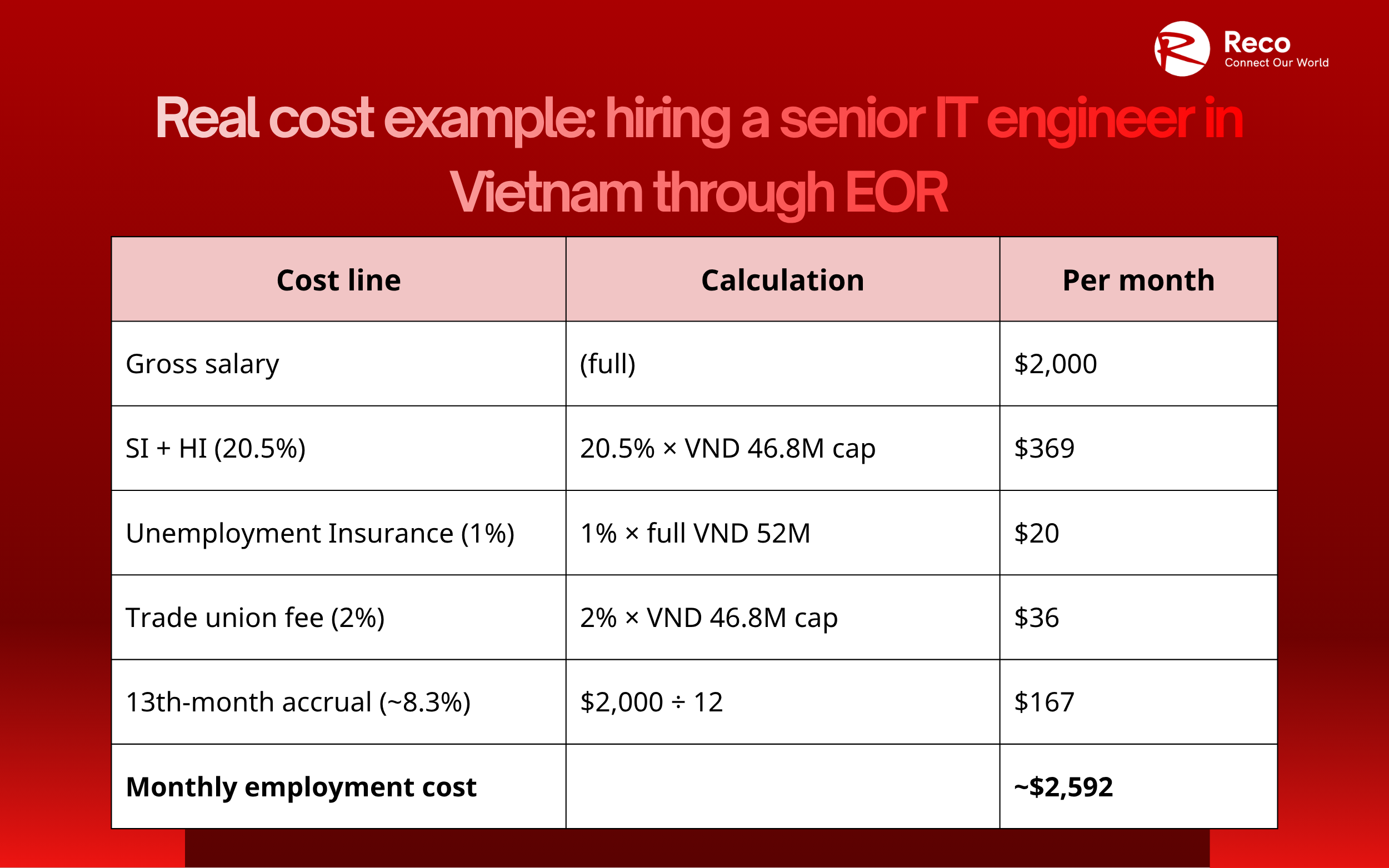
| Cost line | Calculation | Per month |
| Gross salary | (full) | $2,000 |
| SI + HI (20.5%) | 20.5% × VND 46.8M cap | $369 |
| Unemployment Insurance (1%) | 1% × full VND 52M | $20 |
| Trade union fee (2%) | 2% × VND 46.8M cap | $36 |
| 13th-month accrual (~8.3%) | $2,000 ÷ 12 | $167 |
| Monthly employment cost | ~$2,592 |
Statutory subtotal: ~$425/month (effective ~21.2% of gross, because most of the salary clears the SI/HI cap). For a foreign national, drop the $20 UI line; total is ~$20/month lower. If you employ through an EOR, add the provider’s fee on top of this figure.
Reco quotes include the full statutory breakdown: every line, no surprises at invoice. Talk to a Vietnam EOR expert →This is the number to budget against. The fixed costs above (salary, statutory contributions and 13th-month accrual) account for the bulk of what you pay; any provider fee sits on top of them, not in place of them.
To run these numbers for your own salary bands, use an EOR cost calculator that itemizes the full statutory contributions rather than a flat fee, so your estimate matches the eventual invoice.


Looking to hire reliable and highly qualified tech professionals in Vietnam? Reach out to Reco Manpower today for tailored recruitment solutions that match your business needs.
FAQs
The employer statutory contributions for a Vietnamese employee total 23.5% of gross salary: 21.5% for SHUI (Social, Health and Unemployment Insurance) plus a 2% trade union fee. On top of this, the market-standard 13th-month salary adds roughly 8.3% when annualized. SI, HI and the union fee are capped at VND 46.8M/month, so the effective rate falls for high earners.
No, the 13th-month salary is not mandated by the Labour Code. But it is a near-universal market norm, paid by about 90% of companies and effectively required to hire and retain senior IT talent. Budget for it as ~8.3% on top of monthly salary.
Foreign nationals on a work permit with a 12-month-plus contract are exempt from Unemployment Insurance, so the employer SHUI rate drops from 21.5% to 20.5% (total 22.5% with the trade union fee). They still pay Social and Health Insurance at the same rates as Vietnamese employees.