

1. What Is Employee Retention
1.1 Definition of Employee Retention
Employee retention refers to a company’s ability to keep its employees over a period of time. It is typically measured using retention rate, which shows how many employees stay versus those who leave.
A high retention rate often indicates a healthy work environment, while low retention signals deeper organizational issues.
1.2 Why Employee Retention Matters
Poor employee retention doesn’t just mean losing people. It creates a ripple effect across the organization:
- Increased hiring and onboarding costs
- Loss of knowledge and productivity
- Lower team morale
- Weakened employer branding
In many cases, replacing an employee can cost significantly more than retaining one.

2. Why Employee Retention Is a Growing Challenge
2.1 Changing Workforce Expectations
Today’s workforce values more than just salary. Employees are looking for:
- Meaningful work
- Flexibility and work-life balance
- Career growth opportunities
- Transparent leadership
Companies that fail to adapt to these expectations often struggle with employee retention.
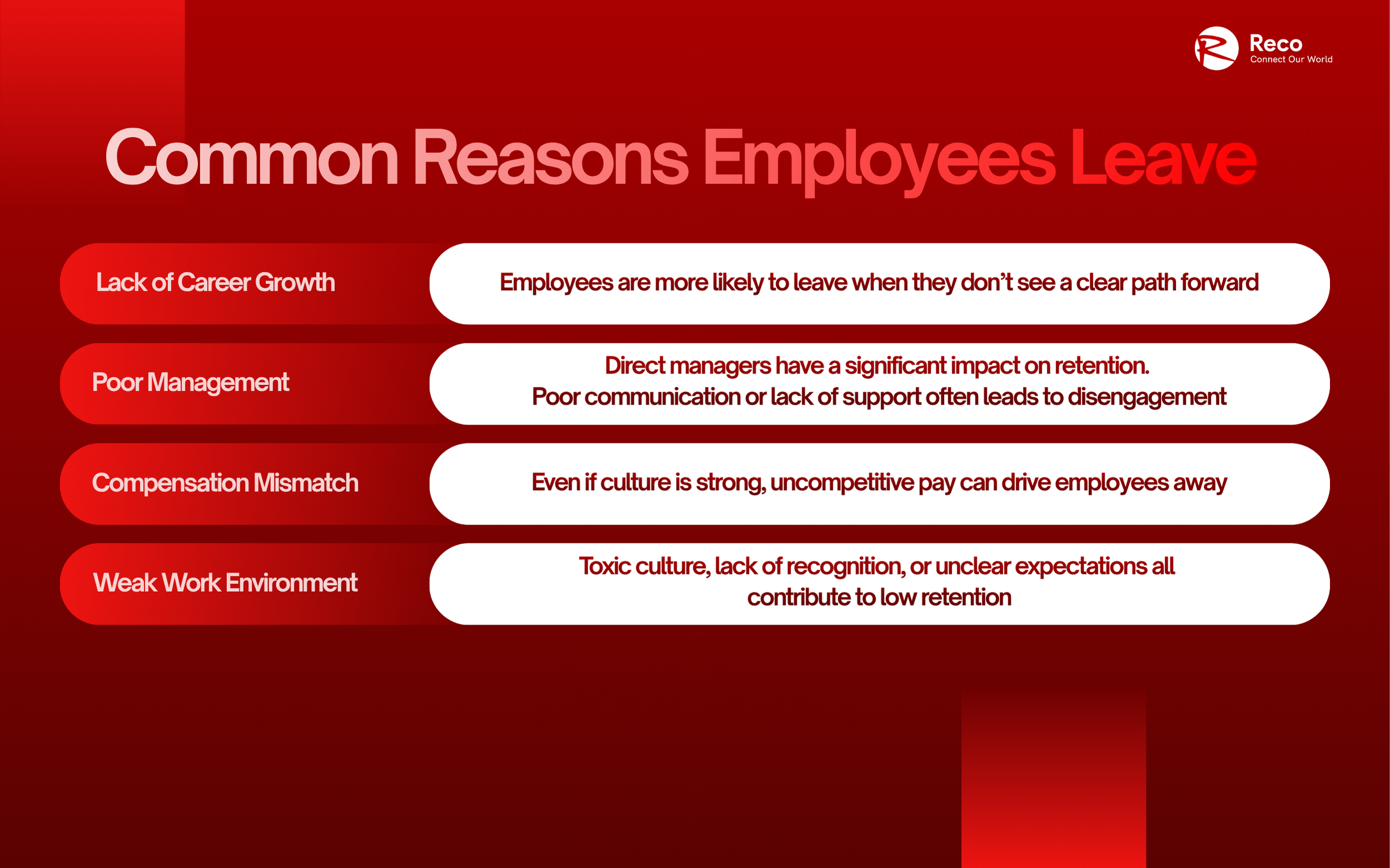
2.2 Common Reasons Employees Leave
Understanding why employees leave is the first step to improving employee retention. In most cases, turnover is not caused by a single issue, but by a combination of unmet expectations over time.
2.2.1 Lack of Career Growth
One of the most common reasons employees leave is the absence of clear development opportunities. When employees don’t see a future within the organization, they start looking elsewhere.
This often happens when:
- There is no defined career path
- Promotions are unclear or inconsistent
- Learning and development opportunities are limited
Over time, even high-performing employees may disengage if they feel “stuck”.
2.2.2 Poor Management
Managers play a critical role in employee retention. Employees may join a company for its brand, but they often leave because of their direct manager.
Common management issues include:
- Lack of communication or feedback
- Micromanagement or lack of trust
- Limited support for employee growth
A weak manager can quickly impact team morale and lead to higher turnover.
2.2.3 Compensation Mismatch
While salary is not the only factor, it remains a fundamental one. Employees expect their compensation to reflect their skills, experience, and market value.
Problems arise when:
- Salary is below market benchmarks
- Pay structures lack transparency
- Rewards are not aligned with performance
Even in a positive work environment, uncompetitive compensation can push employees to leave.
2.2.4 Weak Work Environment
A negative or unclear work environment can significantly reduce employee retention.
This may include:
- Toxic workplace culture
- Lack of recognition or appreciation
- Poor collaboration or team dynamics
- Unclear roles and expectations
Over time, these factors create frustration and disengagement, making employees more likely to leave.
3. Key Employee Retention Strategies
3.1 Build a Strong Work Culture
A positive work culture is one of the most effective employee retention strategies. It creates a sense of belonging and alignment with company values.
Culture is not about perks. It’s about how people are treated daily.
3.2 Offer Competitive Compensation
Salary alone doesn’t guarantee retention, but it remains a baseline expectation.
Companies should ensure:
- Market-aligned compensation
- Transparent salary structure
- Fair reward systems
3.3 Provide Career Growth Opportunities
Employees stay longer when they see growth.
This includes:
- Clear career paths
- Learning and development programs
- Opportunities to take on new challenges
3.4 Improve Leadership and Communication
Strong leadership is a key driver of employee retention.
Managers should:
- Communicate clearly
- Provide regular feedback
- Support employee development
3.5 Recognize and Reward Employees
Recognition helps employees feel valued.
Simple actions like:
- Acknowledging achievements
- Celebrating milestones
- Offering performance-based rewards
can significantly improve staff retention strategies.
3.6 Support Work-Life Balance
Burnout is a major cause of employee turnover.
Companies should:
- Encourage time off
- Avoid overload culture
- Offer flexible working options

4. How to Improve Employee Retention in Practice
4.1 Identify Retention Problems Early
Use tools like:
- Employee surveys
- Exit interviews
- Engagement metrics
Early signals help prevent larger retention issues.
4.2 Use Data to Improve Retention Rate
Tracking retention-related data allows companies to:
- Identify patterns of turnover
- Improve hiring decisions
- Optimize retention strategies
4.3 Build a Long-term Talent Retention Strategy
A strong talent retention strategy is proactive, not reactive.
It focuses on:
- Employee experience
- Long-term engagement
- Continuous improvement
5. Employee Retention Strategies for Different Types of Companies
5.1 Startups
Startups often operate with limited structure, but they compensate with speed and opportunity. For many employees, this environment is attractive because it offers:
- Fast growth opportunities through hands-on experience
- High ownership, where individuals can directly impact outcomes
- Exposure to multiple roles and responsibilities
However, startups typically lack clear processes and stability, which can affect employee retention over time.
In this context, retention is driven more by purpose, learning, and impact rather than long-term security.
5.2 Growing Companies
As companies scale, employee retention becomes more challenging due to increased complexity.
Common issues include:
- Inconsistent processes across teams
- Communication gaps between departments
- Misalignment between leadership and employees
To maintain strong retention, growing companies need:
- Clear and standardized processes
- Strong middle management to bridge strategy and execution
- Consistent and transparent communication
At this stage, staff retention strategies should focus on building structure without losing agility.
5.3 Enterprise Organizations
Large organizations typically have more resources and established systems, but they face different retention challenges, such as bureaucracy or lack of flexibility.
To improve employee retention, enterprises often focus on:
- Structured career paths and internal mobility
- Competitive compensation and benefits packages
- Strong employer branding and employee experience programs
In enterprise environments, a well-defined talent retention strategy is essential to keep employees engaged within a more complex organizational structure.
6. How HR and Leadership Drive Retention
6.1 Role of HR in Retention Strategy
HR plays a central role in shaping and executing an effective HR retention strategy, acting as the bridge between business goals and employee experience. Rather than only handling administrative tasks, HR is responsible for designing systems that support long-term employee retention.
Key responsibilities include:
- Policy design: Building clear, fair, and consistent policies around compensation, benefits, performance, and career development
- Employee engagement programs: Creating initiatives that improve satisfaction, motivation, and connection with the company (e.g., surveys, internal activities, recognition programs)
- Performance systems: Establishing structured evaluation frameworks, KPIs, and feedback loops to ensure employees understand expectations and see their progress
6.2 Role of Managers and Leaders
While HR builds the system, managers and leaders have the most direct and day-to-day impact on employee retention. Employees interact with their managers more than any other part of the organization, which makes leadership behavior a critical factor.
Their responsibilities include:
- Supporting team members: Providing guidance, coaching, and resources to help employees perform and grow
- Creating a positive work environment: Building trust, encouraging collaboration, and maintaining a healthy team dynamic
- Addressing issues early: Identifying signs of disengagement and resolving problems before they lead to turnover
7. Improve Employee Retention with Reco
As organizations grow, maintaining strong employee retention becomes increasingly complex. What works for a small team often breaks down at scale – teams become more distributed, communication becomes fragmented, and employee expectations become more diverse.
Without the right systems and structure, retention efforts tend to be inconsistent. Companies may invest in hiring but struggle to keep the right people long enough to create lasting impact.
Reco approaches employee retention strategies not just from an HR perspective, but from a business and talent lifecycle perspective. Instead of focusing only on filling roles, Reco helps companies build a foundation that supports both hiring and long-term retention.
With Reco, businesses can:
- Gain deeper insights into workforce trends and retention risks
- Align recruitment strategies with long-term retention goals
- Build scalable HR processes that grow with the organization
- Improve overall employee experience through structured systems
The focus is not just on hiring faster, but on hiring and retaining the right talent, ensuring that your workforce remains stable, engaged, and aligned with business growth.
8. Conclusion
Employee retention is not driven by a single factor. It is the result of culture, leadership, compensation, and growth opportunities working together.
Companies that invest in retention don’t just reduce turnover, they build stronger, more resilient organizations.
Looking to hire reliable and highly qualified tech professionals in Vietnam? Reach out to Reco Manpower today for tailored recruitment solutions that match your business needs.
FAQs
Employee retention refers to a company’s ability to keep its employees over time and minimize turnover. It is often measured through retention rate, which reflects how many employees stay within a given period.
A strong employee retention level usually indicates good management, a positive work environment, and effective talent retention strategy.
Employee retention is important because losing employees comes with both direct and hidden costs, including recruitment, onboarding, and productivity loss. Beyond cost, strong staff retention strategies help maintain team stability, preserve institutional knowledge, and strengthen employer branding in the long run.
3 What are effective employee retention strategies?
Effective employee retention strategies go beyond salary. They typically include:
- Building a strong and transparent work culture
- Offering competitive and fair compensation
- Providing clear career growth opportunities
- Developing strong leadership and communication
A well-rounded HR retention strategy focuses on both employee experience and long-term engagement.
Effective employee retention strategies go beyond salary. They typically include:
- Building a strong and transparent work culture
- Offering competitive and fair compensation
- Providing clear career growth opportunities
- Developing strong leadership and communication
A well-rounded HR retention strategy focuses on both employee experience and long-term engagement.
To improve employee retention rate, companies should take a proactive approach:
- Identify early signs of disengagement (e.g., surveys, feedback)
- Use data to understand turnover patterns
- Continuously improve employee experience
- Align hiring with long-term retention goals
The most effective approach to how to improve employee retention is to address root causes rather than reacting after employees leave.
Low employee retention is often driven by a combination of factors, including:
- Poor management or lack of support
- Limited career growth opportunities
- Compensation that is not competitive
- Weak or unclear work environment
Without the right employee retention strategies for companies, these issues can accumulate over time and lead to high turnover.