 1. Is EOR Still the Right Model for You?
EOR is well-suited for foreign companies that need to hire in Vietnam quickly, without the time or cost of establishing a local legal entity. As the Employer of Record, the EOR provider employs your staff on your behalf, handling payroll, SHUI contributions, PIT compliance, and labor contracts — while your team works under your direction day to day.
It is the right model when:
| Condition | Why it matters |
| You are hiring 1–20 employees | EOR fees are cost-effective at this headcount |
| Speed to market is the priority | You can have a compliant employee on payroll within days |
| You are testing the Vietnam market | No long-term entity commitment required |
| You have no Vietnamese legal entity | EOR acts as the legal employer on your behalf |
Related reading: For a full explanation of how EOR works in Vietnam — including contract structures, SHUI obligations, and what “employer of record” means under Vietnamese labor law — see our complete EOR Vietnam guide. [Internal link → EOR pillar page]
2. EOR vs BOT vs Local Entity: Which Model Fits Your Stage?
EOR is not the only path for foreign companies building a team in Vietnam. Understanding all three options prevents you from choosing a structure you will need to undo six months later.
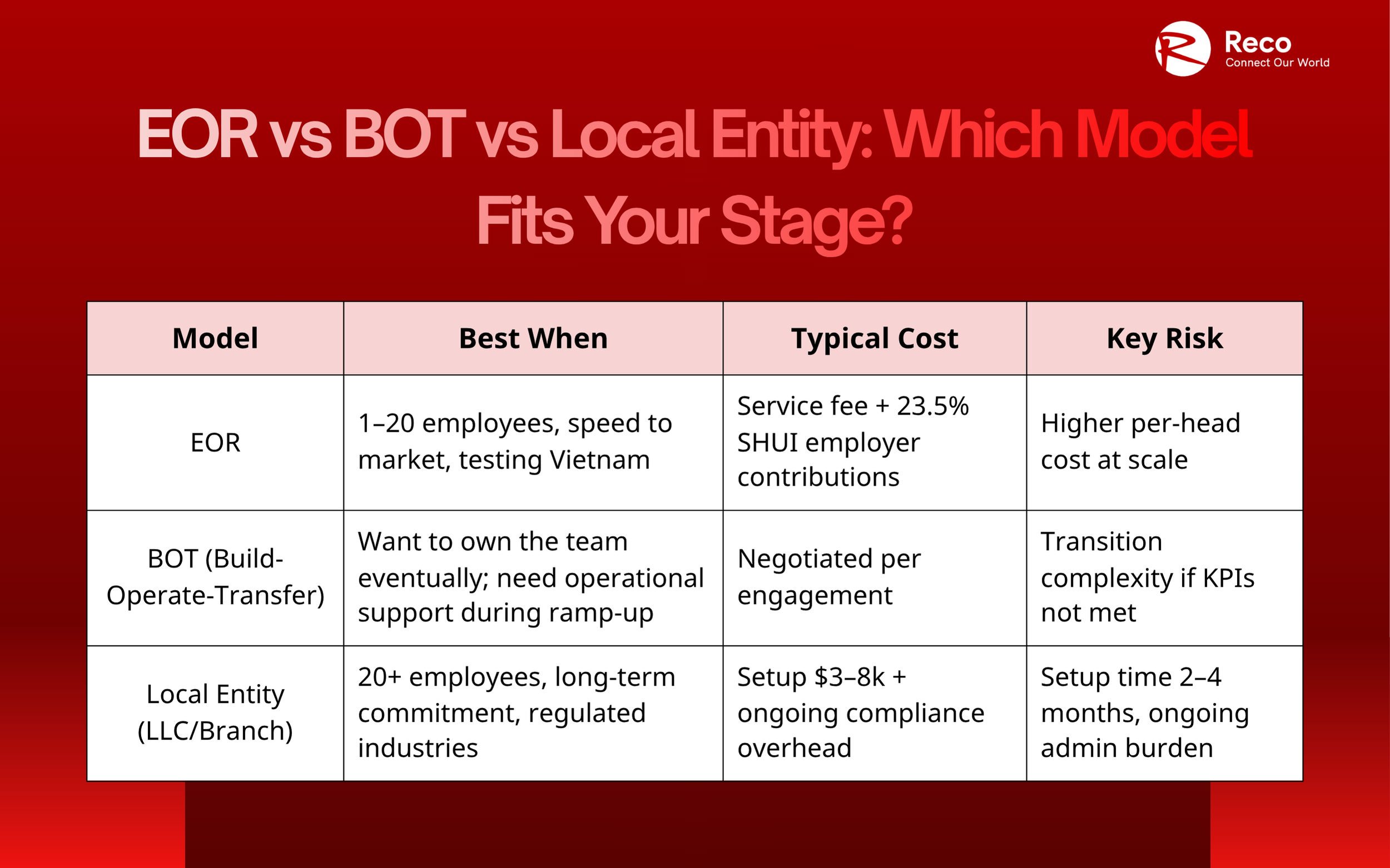
| Model | Best When | Typical Cost | Key Risk |
| EOR | 1–20 employees, speed to market, testing Vietnam | Service fee + 23.5% SHUI employer contributions | Higher per-head cost at scale |
| BOT (Build-Operate-Transfer) | Want to own the team eventually; need operational support during ramp-up | Negotiated per engagement | Transition complexity if KPIs not met |
| Local Entity (LLC/Branch) | 20+ employees, long-term commitment, regulated industries | Setup $3–8k + ongoing compliance overhead | Setup time 2–4 months, ongoing admin burden |
A few points worth expanding on:
EOR gives you speed. You can have a compliant employee on payroll within days. The tradeoff is cost per head — EOR fees typically run 10–15% of gross salary on top of the 23.5% SHUI employer contribution. At small headcount, that is worth it. At 20+ employees, the math changes.
BOT gives you ownership. The Build-Operate-Transfer model allows a provider to build and manage your offshore team under defined KPIs, then transfer full ownership to you when you are ready. It is the right choice if you want the long-term benefit of a dedicated team without starting from scratch on operations, recruitment, and management infrastructure.
A local entity gives you control — and cost efficiency at scale. Once you exceed 20 employees, the economics typically favor entity setup. You also gain access to Vietnam’s corporate tax incentives (as low as 10% for qualified High-Tech enterprises) and a cleaner path to ESOP issuance.
3. 4 Clear Signals It Is Time to Move Beyond EOR
EOR is a bridge, not a destination. Here are the four signals that the bridge is ending:
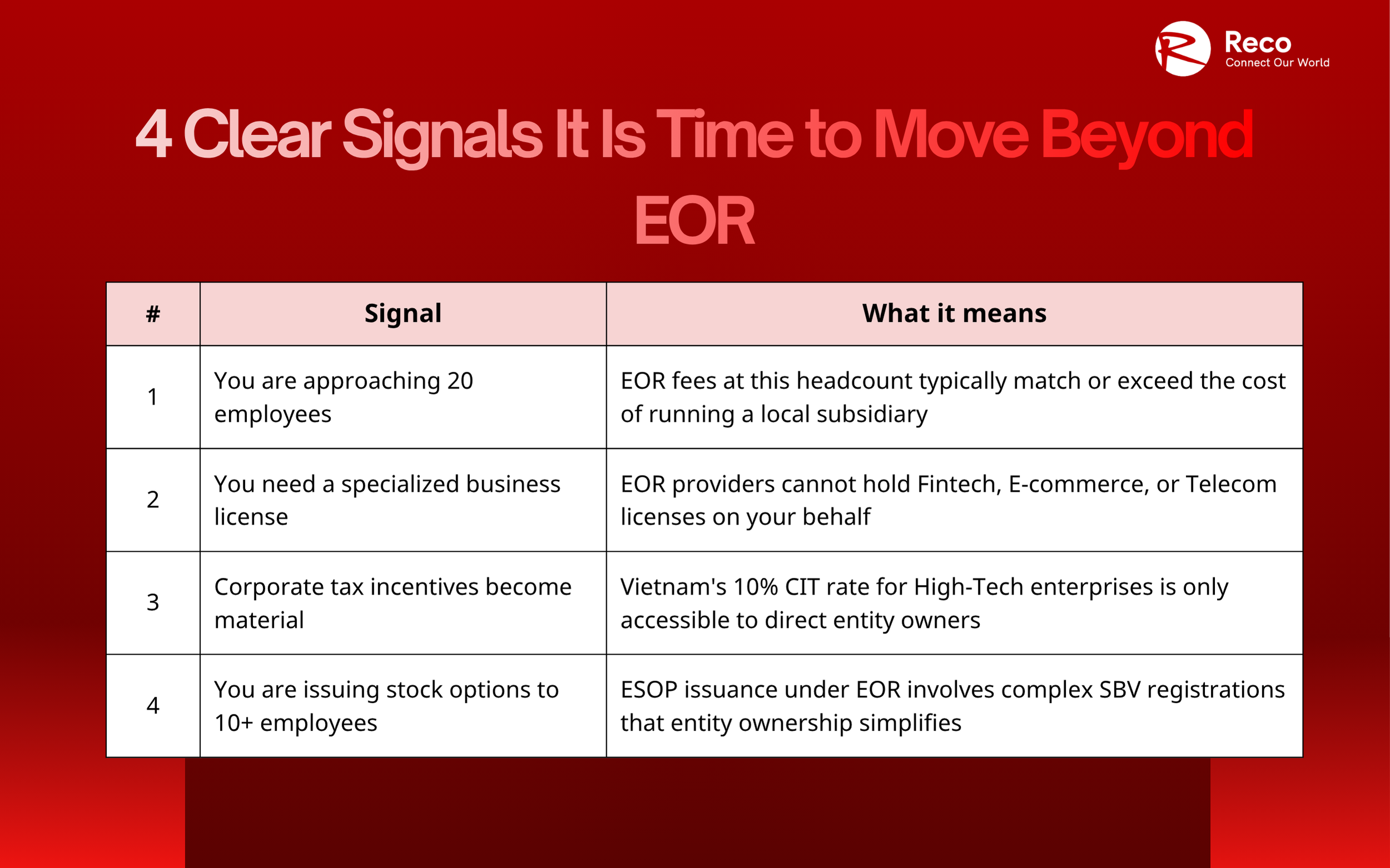
| # | Signal | What it means |
| 1 | You are approaching 20 employees | EOR fees at this headcount typically match or exceed the cost of running a local subsidiary |
| 2 | You need a specialized business license | EOR providers cannot hold Fintech, E-commerce, or Telecom licenses on your behalf |
| 3 | Corporate tax incentives become material | Vietnam’s 10% CIT rate for High-Tech enterprises is only accessible to direct entity owners |
| 4 | You are issuing stock options to 10+ employees | ESOP issuance under EOR involves complex SBV registrations that entity ownership simplifies |
Signal 1 – You are approaching 20 employees
The aggregate monthly EOR fees for a 20-person team typically approach or exceed the cost of running a local subsidiary with in-house HR and accounting. This is the financial inflection point most providers agree on. If your Vietnam headcount is growing steadily, model the numbers at 15 employees — not 25, when it may already be too late to plan a clean transition.
Quick check: At 15+ employees, request a cost comparison from your EOR provider between continued EOR fees and projected entity operating costs. A credible provider will give you this analysis honestly.
Signal 2 – You need a specialized business license
EOR providers cannot hold Fintech, E-commerce, or Telecommunications licenses on your behalf. If your product or operations require local regulatory approval — a payment gateway license, a trading license, or a telecom permit — EOR is a bridge, not a permanent solution. You will need your own entity.
Signal 3 – Corporate tax incentives become material
Vietnam offers Corporate Income Tax rates as low as 10% for 15 years for qualified High-Tech enterprises. These incentives are only accessible to direct entity owners. At scale, the tax saving can significantly outweigh the administrative cost of running a local company. If your Vietnam operations are profitable and growing, this warrants a serious calculation.
Signal 4 – You are issuing stock options to 10+ Vietnam employees
Issuing ESOPs under an EOR arrangement involves foreign exchange regulations and State Bank of Vietnam registrations that become increasingly complex beyond a certain headcount. Entity ownership simplifies this structure considerably and reduces legal exposure for both the company and the employee.
4. 5 Questions to Ask Any EOR Provider Before Signing

The Vietnam EOR market includes global platforms, regional specialists, and local providers. The questions below separate providers with genuine Vietnam depth from those that list it as a “supported country” while routing your contracts through a third-party partner.
- Has your Employment Law 2025 compliance been implemented? Are employment contracts and payroll systems updated for unemployment insurance obligations on fixed-term contracts of one month or more? If your provider cannot confirm implementation, your contracts may already be non-compliant.
- Do you own your legal entity in Vietnam, or are you using a local partner? Partner-based models add a layer of risk and potential delay — particularly in termination scenarios, regulatory inquiries, or disputes. The answer matters more than the provider’s marketing language about “local expertise.”
- What does your IP Assignment clause cover under Vietnamese law? Ask to see the specific contract language, not a summary. If your team is building software or creating proprietary content, this clause needs to be explicit and enforceable.
- What is your documented termination process, and who bears the legal liability? Termination in Vietnam is not at-will. The Labor Code sets out specific grounds, notice periods, and severance obligations. Vague answers here are a red flag.
- If I reach 20 employees and want to transition to a local entity, what support do you provide? A strong EOR provider plans for this conversation from day one. They should be able to walk you through a transition roadmap — including timeline, documentation handover, and whether they offer entity setup support or can refer a trusted partner.
How Reco approaches this: Reco operates its own legal entity in Vietnam and offers both EOR and BOT models — which means the transition conversation is built into how we work with clients from the start. If you reach the point where a local entity or a BOT structure makes more sense, we can support that move rather than losing you to a competitor. [Internal link → Reco EOR service page]
Not Sure Which Model Fits Your Stage?
The right structure depends on your headcount today, your growth trajectory, and whether you need regulatory licenses in Vietnam. Most companies that start with EOR find it works well for the first 12–18 months — and the transition to a different model is straightforward when planned in advance.
Reco helps foreign companies across Singapore, Australia, and Japan hire and manage IT talent in Vietnam — whether through EOR, BOT, or direct placement. Our team can walk you through a model comparison based on your current situation.

Looking to hire reliable and highly qualified tech professionals in Vietnam? Reach out to Reco Manpower today for tailored recruitment solutions that match your business needs.
FAQs
With a reputable provider, an employee can be on payroll within a few days to two weeks. This is significantly faster than establishing a local entity, which typically takes 2–4 months.
At small headcount, yes. EOR eliminates the upfront entity setup cost ($3–8k) and the ongoing compliance overhead. As your team grows, however, the per-head EOR fees typically begin to approach — and eventually exceed — the cost of running a local subsidiary. Most companies reach this crossover point somewhere between 15 and 25 employees.
No. EOR providers can employ your staff and manage payroll compliance, but they cannot hold industry-specific licenses — such as Fintech, E-commerce, or Telecommunications permits — on your behalf. If your operations require regulatory approval, you will need your own legal entity.