BOT (build operate transfer) enables technology companies to access Vietnam’s deep IT talent pool through a proven partner who handles recruitment, HR, compliance, and team management on your behalf. Once the team is embedded in your workflows and performing at full capacity, ownership transfers entirely to you include people, IP, infrastructure, and all.
This guide covers the full build operate transfer meaning, how each phase of the BOT model works, how build operate transfer services compare to other engagement models, a real client case study, and how Reco executes it for technology companies worldwide.

1. What Is Build Operate and Transfer (BOT)? Definition & Meaning
| Build operate and transfer definition: BOT is an engagement model in which a specialist partner builds a dedicated offshore team for a client, operates and manages it for an agreed period, and then transfers full ownership — people, processes, IP, and infrastructure — to the client. The result is a permanent, in-house technology team that the client controls entirely, without the complexity of setting up a foreign entity from scratch. |
Understanding what is build operate transfer helps clarify why it differs from traditional vendor arrangements. Where a typical staffing or managed services contract keeps the vendor in control indefinitely, the build-operate-transfer model is engineered from day one to hand full control to the client. The vendor’s success is measured by how cleanly the transfer happens — not by how long they retain the relationship.
In the technology sector, the build-operate-transfer model in Vietnam has become one of the most strategic approaches for companies wanting to establish dedicated engineering, QA, data, or DevOps capabilities — a market recognized for technical depth, strong English communication, adaptability to international team cultures, and a rapidly growing pool of senior software professionals.
1.1. How Does the Build Operate and Transfer Model Work?
| The build-operate-transfer model runs in three sequential phases: Build (Reco sets up your team from scratch), Operate (Reco manages daily operations while you maintain full strategic control), and Transfer (complete ownership — people, contracts, tools, and IP — moves to you). Each phase has defined milestones and governance checkpoints agreed upfront. |
Here is what each phase looks like in practice:
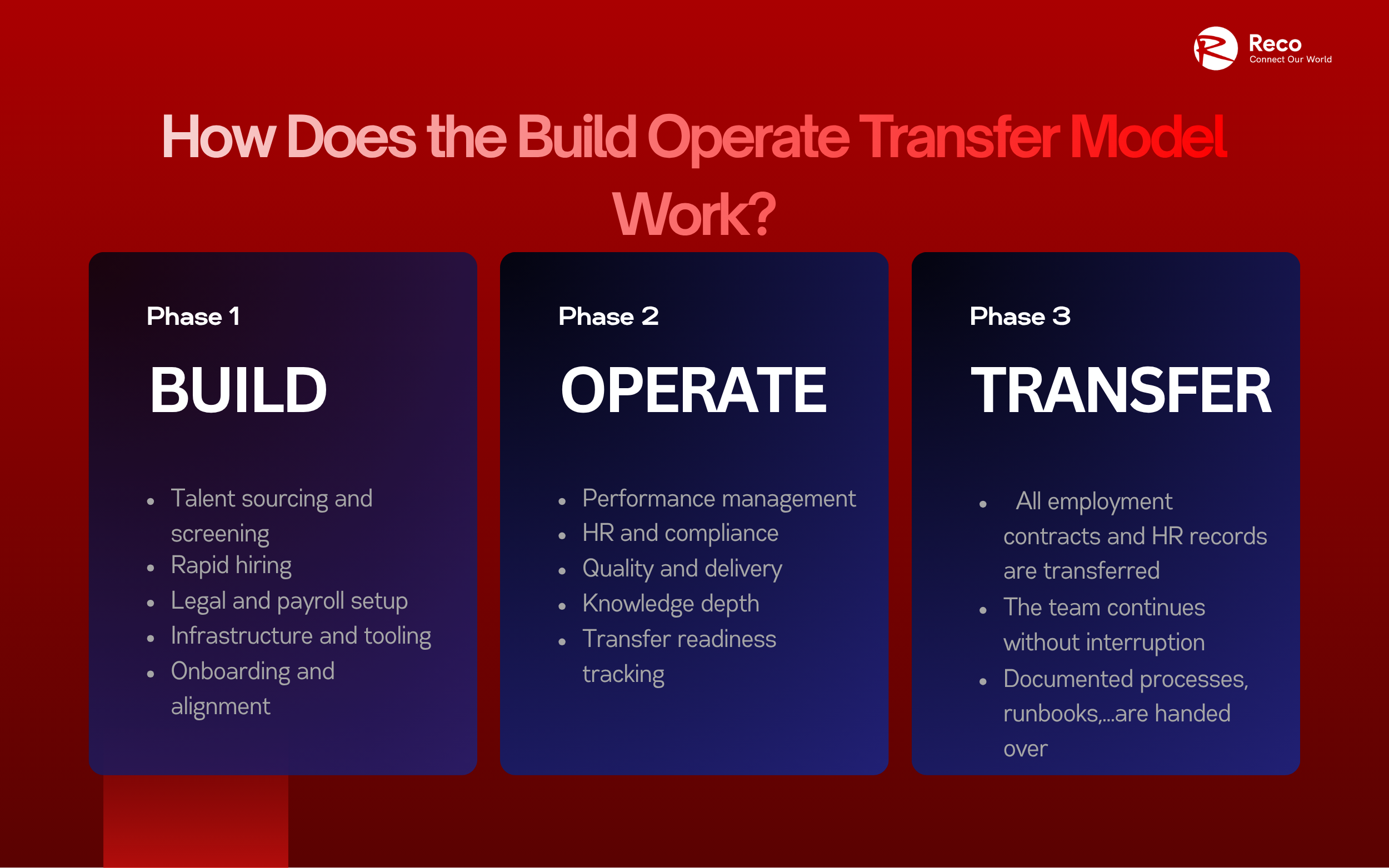
Phase 1 — BUILD: From Brief to Operational Team
Reco takes on full responsibility for establishing your dedicated unit in Vietnam:
- Talent sourcing and screening — drawing from Reco’s database of 330,000+ vetted IT professionals to identify candidates that match your technical requirements and team culture.
- Rapid hiring — Reco’s RECO 7 methodology means qualified candidates are proposed within 7 days of brief confirmation, from Propose to Interview to Hire.
- Legal and payroll setup — employment contracts, local labor law compliance, mandatory insurance, and payroll management are handled entirely by Reco. No Vietnam entity required on your side.
- Infrastructure and tooling — development environments, communication platforms, security protocols, and project management systems are provisioned to your specifications.
- Onboarding and alignment — your new team is integrated into your existing codebases, workflows, and engineering standards before they are operational.
Typical Build phase duration: 4–10 weeks depending on team size and seniority requirements.
Phase 2 — OPERATE: Full Performance Under Your Direction
Once the team is operational, Reco manages day-to-day people operations while you maintain total authority over technical direction, product roadmap, and performance standards:
- Performance management — OKRs, regular reviews, and continuous improvement cycles run by Reco’s delivery managers.
- HR and compliance — payroll, benefits, local regulatory compliance, and team expansion are managed by Reco throughout this phase.
- Quality and delivery — the team works directly in your workflows, with SLAs and delivery standards you define.
- Knowledge depth — the team accumulates institutional product knowledge during this phase, which becomes a critical asset at Transfer.
- Transfer readiness tracking — Reco runs structured milestones throughout the Operate phase to ensure Transfer happens without disruption.
Typical Operate phase duration: 12 to 36 months, agreed at contract stage.
Backed by 6+ years of IT HR expertise, Reco helps businesses hire exceptional tech talent across local and global markets — explore what we offerPhase 3 — TRANSFER: Full Ownership, Zero Disruption
Transfer is the milestone the entire engagement is built toward. Reco ensures the handover is complete and clean:
- All employment contracts and HR records are transferred to your entity or to a Vietnam subsidiary Reco helps you establish.
- Codebases, IP, infrastructure, and vendor accounts are transferred in full.
- Documented processes, runbooks, onboarding guides, and institutional knowledge are handed over in client-accessible systems.
- The team continues without interruption — same people, same workflows, now fully under your ownership.
After Transfer, Reco’s involvement ends — or continues in a reduced advisory role for a defined stabilization period if preferred.
2. How Does BOT Compare to Staff Augmentation and Traditional Hiring?
| BOT, Staff Augmentation, and direct hiring serve different needs. BOT is the right model when you want to build a permanent, owned technology capability in Vietnam with expert support through the setup and growth stages — not a vendor relationship you manage indefinitely. |
| Criteria | Build Operate and Transfer (with Reco) | Staff Augmentation |
| Goal | Build a permanent client-owned team in Vietnam | Flexible capacity to supplement existing team |
| Ownership | Full ownership transferred to client | Talent stays on Reco’s or client’s payroll; relationship is ongoing |
| IP & codebase | 100% transferred to client at handover | Belongs to client; no transfer event needed |
| Long-term cost | Management fee ends after Transfer; only direct employment costs remain | Ongoing service fee for as long as talent is engaged |
| Control | Client controls technical direction from day one; operational control increases toward 100% | Client manages day-to-day; Reco handles HR and admin |
| No VN entity needed | Yes — Reco acts as employer of record during Operate phase | Yes — same EOR structure available |
| Best for | Companies building strategic, permanent tech capabilities in Vietnam | Companies needing fast, flexible team scaling without long-term commitment |
| Reco advantage | 330,000+ candidate database; RECO 7 hiring speed; 3,000+ placements track record | Same talent network; scalable up or down; no Transfer complexity |
3. What Is the Difference Between BOT and BTO?
| BTO stands for Build-Transfer-Operate. In BTO, ownership transfers to the client immediately after the Build phase, and the client operates the team from day one. BOT keeps the provider managing operations for an agreed period before Transfer — reducing risk for clients who are not yet ready to manage an offshore team independently. |
In technology team building:
- BOT is suited for companies that want a specialist partner to manage people operations, performance, and HR compliance during the growth phase — before taking full ownership of a proven, high-performing team.
- BTO is suited for companies with existing internal management infrastructure who want a partner to recruit and set up the team, but are ready to manage it themselves from the start.
For most companies engaging Reco for offshore team building, BOT is the more practical path. It provides a structured ramp-up, compliance assurance, and a clean Transfer — rather than putting the client immediately in the position of managing Vietnam employment law and HR operations.
4. What Is the Difference Between DBOT and BOT?
| DBOT adds a Design phase before Build. The provider first architects the team structure, tech stack, and operating model before any hiring begins. It is appropriate for engagements where the client has no existing blueprint — entering a new technical domain, building a net-new capability, or establishing a Vietnam development center from scratch with no internal reference point. |
Standard BOT assumes the client has a reasonably clear vision of the team they need. DBOT is the right starting point when:
- The client is building a type of team they have never built before (e.g. an AI/ML function within a traditionally non-tech business).
- There is no existing team structure to replicate offshore.
- Significant upfront consulting and solution architecture work is needed before hiring can begin.
Reco works with clients during the initial discovery phase to determine whether a standard BOT or a DBOT engagement is the right fit.
5. Is BOT a Form of Public-Private Partnership (PPP)?
| Yes — in infrastructure and public finance, BOT is one of the most established PPP structures, used for toll roads, power plants, and airports. However, in the context of technology team building and IT workforce solutions, BOT describes a commercial engagement between private companies. The underlying logic — build, prove, transfer — is the same, but the application is entirely different. |
When evaluating BOT for technology team building, the relevant questions are about talent quality, HR and compliance infrastructure, knowledge transfer methodology, and the partner’s track record of executing successful transfers — not public finance structures.
Reco’s BOT service is purpose-built for technology companies looking to access Vietnam’s IT talent market and build a team they own. It has no relationship to government concession agreements.
6. Build Operate and Transfer Examples: Reco Client Case Studies
| The following is a real Reco BOT engagement showing how a European SaaS company used the build operate transfer model in Vietnam to build a 10-person elite engineering team — with 0% turnover and full operational stability. |
Case Study 1 — Entertainment SaaS Scale-Up: 0% Turnover, 10 Engineers, Ireland HQ
| Industry | Entertainment / B2B SaaS (Gambling Technology) |
| Client location | Ireland — European HQ |
| Service | BOT — Build Operate Transfer |
| Team built | 10 senior engineers: .NET developers, Tech Lead, Full-stack tester, Backend & Frontend (ReactJS) |
| Operating model | Hybrid — Hanoi and Ho Chi Minh City |
| Timeline | 24-month build objective, engagement ongoing since 2023 |
| Turnover rate | 0% |
| Time to onboard | 30–45 days per hire |
The Challenge
The client is a leading European B2B technology provider for the gambling industry. Its platform processes millions of transactions daily, where performance, uptime, and security are non-negotiable. Scaling the engineering team globally was essential, but the company faced three hard constraints entering Vietnam:
- Market knowledge gap: No familiarity with Vietnamese labor law, tax regulations, and cultural nuances that govern senior tech hiring.
- Talent scarcity: The requirement was not for generalist developers — the client needed top 1% engineers with fluent English and deep expertise in specialized stacks (.NET, ReactJS). Standard recruitment channels would not reach this segment.
- Operational risk: The engagement required a BOT model structured for long-term stability and high-performance output from day one, not a volume-hiring approach.
Reco’s Build Operate and Transfer Model Approach
Reco designed a tailored build-operate-transfer process that prioritized quality and stability over speed:
Dedicated HR team structure: Rather than assigning a standard recruiter, Reco embedded a specialist team into the engagement — one Team Lead with 10+ years of experience providing strategic oversight and governance, three Senior HR Consultants focused on senior tech hiring and compliance, and one dedicated Account Manager ensuring constant alignment between the Ireland HQ and the Vietnam team. This structure made Reco function as an embedded extension of the client’s organization, not an external vendor.
Differentiated retention framework: Reco designed a benefits package specifically built to attract and retain Vietnam’s top engineering talent — 100% probation salary and social insurance from day one, family health insurance, annual international company trips, a unique policy allowing the full Vietnam team to work onsite at European HQ once per year, and financial assistance for home and car purchases to reinforce long-term commitment.
A custom talent pool was built for the client, with a strict 6-month probation period to assess technical quality and cultural fit before any engineer was considered a permanent team member.
Results
| Metric | Result |
| Time to onboard | 30–45 days per hire |
| Team size (2025) | 10 engineers |
| Turnover rate | 0% |
| Cost savings | Significant reduction in office, HR and recruitment costs vs equivalent European hiring |
| Team stability | Fully operational, scaling on original roadmap |
The BOT team is now stable and efficient, ensuring seamless scale-up aligned with the original roadmap. The client now operates a fully integrated Vietnam hub with zero friction — entirely focused on product innovation while Reco manages the complexity of local operations.
| “We’re satisfied with Reco’s services and the IT talent they delivered. Our team scaled stably following the original roadmap. We will prioritize Reco as our HR partner in Vietnam when recruiting new IT roles.”
Chloe Nguyen | Client, Entertainment SaaS Scale-Up |
7. What Do Reco’s Build Operate Transfer Services Include?
| Reco’s BOT service covers everything from talent sourcing to Transfer execution: rapid hiring via the RECO 7 model, full HR and payroll management, no Vietnam entity required on the client side, ongoing team performance management, and a structured, documented Transfer with zero disruption to operations. |
Here is the full scope of what Reco manages across all three BOT phases:
| Service Component | What Reco Delivers |
| Talent Sourcing | Access to 330,000+ vetted Vietnam IT professionals. Reco sources, screens, and presents qualified candidates matched to your technical stack and team culture. |
| RECO 7 Hiring Speed | From brief to first candidates in 7 days. From first interview to hire in one structured process. No drawn-out hiring cycles. |
| EOR / No Entity Needed | Reco acts as the legal employer during the Operate phase. No Vietnam entity, no local HR team required on the client side until Transfer. |
| Payroll & HR Compliance | Full payroll management, mandatory insurance, benefits administration, and Vietnam labor law compliance — handled by Reco’s local HR team. |
| Team Management | Day-to-day operations, performance reviews, OKRs, and delivery oversight managed by Reco’s delivery consultants. Technical direction stays with the client. |
| Reporting & Transparency | Regular performance reports, Transfer readiness assessments, and direct access to team metrics throughout the engagement. |
| Transfer Execution | Complete handover: contract novation, entity setup guidance, IP and tooling transfer, and documented knowledge base. Zero disruption to the team’s delivery. |
| Post-Transfer Support | Optional 3–6 month advisory support after Transfer to ensure smooth transition to independent operations. |
Reco builds BOT teams across a wide range of technology disciplines, including product engineering, QA automation, data engineering, DevOps, cloud infrastructure, AI/ML, and platform architecture.
Read more: Key Factors of Build-Operate-Transfer Contract in Vietnam8. Why Choose Reco as Your BOT Partner in Vietnam?
Choosing the right partner is the most consequential decision in a BOT engagement. The Build phase determines team quality. The Operate phase determines whether the team develops the depth needed for a clean Transfer. A poorly executed Transfer creates legal, operational, and people risk that takes years to resolve.
Reco has been building and operating dedicated technology teams in Vietnam since 2019. Here is what that track record looks like:
| 500+
Clients served |
3,000+
Placements made |
50+
IT teams built |
70+
Specialist consultants |
Reco is recognized by the Sao Khue Award 2024 — Vietnam’s leading technology excellence award — and is Clutch-honored for client satisfaction. These recognitions reflect consistent delivery across recruitment, team management, and Transfer execution.
| What clients need from a BOT partner | How Reco delivers it |
| Access to top-tier Vietnam IT talent, fast | 330,000+ candidate database. RECO 7 model delivers first candidates within 7 days of brief confirmation. |
| A team that is a true extension of their organization | Reco’s onboarding process aligns the team with the client’s culture, tools, and engineering standards from week one — not just headcount. |
| No Vietnam entity required | Reco’s EOR infrastructure handles all local employment obligations. Clients operate legally in Vietnam from day one without a subsidiary. |
| Full decision-making authority | The client controls all technical direction, workflows, performance standards, and tooling throughout the engagement. Reco manages people operations. |
| Transparency through the engagement | Monthly performance reports, Transfer readiness milestones, and direct communication with Reco’s delivery managers keep clients fully informed. |
| A clean Transfer with no disruption | Reco’s Transfer methodology covers HR record handover, IP transfer, entity setup support, and a stabilization period. The team does not miss a beat. |
| Long-term fit, not just headcount | Reco screens for technical capability and cultural alignment. Retention rates through Transfer are high because the team is built to last, not just to fill roles. |
9. What Type of Company Is the Right Fit for Reco’s BOT Model?
| Reco’s BOT model is designed for technology companies that want to build a permanent Vietnam-based technology team, need speed to market, and want a structured path to full ownership without setting up a Vietnam entity from day one. |
BOT with Reco is a strong fit when:
- You need a dedicated team of 5 or more technology professionals with long-term, ongoing workloads.
- You want to own the team permanently — not pay an ongoing vendor margin for access to people you do not employ.
- You have an internal technical owner (CTO, VP Engineering, or Product Lead) who will provide strategic direction to the team.
- You are scaling a product, platform, data function, or engineering capability — not delivering a time-bounded project.
- You do not yet have a Vietnam legal entity but plan to establish one during or after the Operate phase.
Industries Reco serves with BOT teams include:
- SaaS platforms and product engineering
- BFSI — banking, financial services, insurance
- E-commerce and marketplace technology
- EdTech and learning platform development
- IT consulting and global delivery models
- PropTech and real estate SaaS
- TravelTech — booking engines, API integration, GDS
- Gaming and interactive media
- Manufacturing technology and Industry 4.0
If you are unsure whether BOT or Staff Augmentation is the right fit for your situation, Reco offers a no-commitment consultation to assess your requirements and recommend the most appropriate engagement structure.
10. What Are the Risks of BOT — and How Does Reco Manage Them?
BOT is a strategic, long-term engagement. Understanding where risks arise — and what governance mechanisms prevent them — is essential before making a commitment.
| Risk | What Can Go Wrong | Reco’s Mitigation |
| Talent quality | Team is built with the wrong seniority mix or technical skills, creating delivery issues that are hard to fix mid-engagement. | Reco co-designs the team spec with the client’s technical lead before sourcing begins. Technical assessments are shared with the client and require approval before offers are made. |
| Knowledge siloing | Critical product knowledge lives in systems the client cannot access, making Transfer painful and incomplete. | Reco mandates documentation standards from month one. All knowledge is captured in client-accessible systems (GitHub, Confluence, Notion) as a Transfer readiness requirement. |
| Transfer delay or obstruction | Some providers delay Transfer to preserve revenue, leaving clients in an indefinite vendor relationship. | Reco’s engagement contract includes Transfer milestones, timelines, and legal obligations with defined consequences for delay. Transfer is the intended outcome — Reco’s reputation depends on executing it. |
| Legal complexity at Transfer | Setting up a Vietnam entity or transferring employment contracts is more complex than expected, stalling the handover. | Reco provides a Transfer readiness checklist, legal entity setup guidance, and coordinates with local legal counsel to simplify the process for the client. |
| Team attrition at Transfer | Team members leave when ownership changes, destroying the institutional knowledge the engagement was built to create. | Reco maintains strong employer relationships throughout the Operate phase. Clients are encouraged to offer retention packages ahead of Transfer, and Reco actively supports this process. |
11. Best Practices for Communication With Vietnamese IT Teams Under a BOT Framework
| Effective communication with a Vietnam-based team under a BOT model requires a structured approach from the very start of the Build phase — not something improvised after the team is operational. The most successful engagements establish clear communication rituals, shared tooling, and cultural alignment before the first line of code is written. |
Communication breakdowns are among the most common sources of friction in offshore team engagements. Under a BOT model, where the client’s technical leadership guides the team while the provider manages people operations, getting communication right is a shared responsibility.
Establish a Communication Structure in the Build Phase
Before the team is fully onboarded, define and agree on:
- A single point of contact on both sides — the client’s technical owner and Reco’s delivery manager — responsible for escalation and alignment.
- A meeting cadence: daily standups for the team, weekly syncs between the client’s technical lead and Reco’s delivery manager, monthly reviews covering delivery performance and team health.
- Communication tooling — agree on which platforms the team will use (Slack, Teams, Jira, Confluence) and configure access before day one.
- Response time expectations — especially relevant across time zones. Define what counts as urgent versus asynchronous.
Work With Vietnam’s Communication Culture, Not Against It
Vietnamese IT professionals are technically strong and highly adaptable to international team environments. A few cultural considerations improve collaboration significantly:
- Direct feedback works well but benefits from being delivered in a structured context — such as a dedicated feedback session — rather than in public group settings.
- Vietnamese engineers tend to be thorough and detail-oriented. Requirements that are ambiguous or frequently changed mid-sprint create friction; investing in clear specs upfront pays dividends throughout the Operate phase.
- English proficiency in Vietnam’s IT sector is generally strong, particularly in written communication. Video calls benefit from clear audio and a slightly slower pace for complex technical discussions.
- Recognize local holidays and working patterns. Vietnam observes Tet (Lunar New Year) as its most significant holiday — plan sprints and delivery milestones accordingly.
Use the Operate Phase to Build Communication Maturity
One of the most valuable outcomes of a well-run Operate phase is a team that communicates proactively — surfacing blockers early, documenting decisions, and operating with the transparency needed for a clean Transfer. Reco’s delivery managers actively coach teams on communication standards during this phase, so that by Transfer, the team functions as a genuinely integrated extension of the client’s organization.
12. How to Legally Set Up a Tech Entity in Vietnam After the BOT Contract Ends
| After a BOT engagement, the most common legal structure for clients is a Foreign-Invested Enterprise (FIE) — typically an LLC (Limited Liability Company) — established under Vietnam’s Law on Enterprises and Law on Investment. Reco supports clients through this process during the Operate phase so that the entity is ready well before the Transfer date. |
Setting up a legal entity in Vietnam is a well-established process for foreign technology companies, but it requires planning. Starting 6–9 months before the intended Transfer date is strongly recommended.
Common Entity Structures for Foreign Tech Companies in Vietnam
| Entity Type | Best Suited For |
| 100% Foreign-Owned LLC (FIE) | Most common for tech companies. Full foreign ownership, straightforward compliance, suitable for employing staff and holding IP. |
| Representative Office | For market research and liaison only — cannot employ staff directly or generate revenue. Not suitable for BOT Transfer. |
| Joint Venture | Less common for pure tech teams. Involves a Vietnamese partner holding equity. Useful in specific regulated industries. |
| Branch Office | Extension of a foreign company. Can conduct business but has limited scope; less common for dedicated engineering teams. |
Key Steps to Establish a Vietnam LLC Before Transfer
- Step 1 — Investment Registration Certificate (IRC): Filed with the Department of Planning and Investment (DPI). Requires business plan, capital commitment, and investor documentation. Typical processing time: 15–30 business days.
- Step 2 — Enterprise Registration Certificate (ERC): Issued after IRC approval. Formally incorporates the company under Vietnamese law.
- Step 3 — Tax registration and seal: Register for tax codes, VAT, and corporate income tax. Obtain the company seal.
- Step 4 — Bank account and charter capital: Open a corporate bank account and transfer the declared charter capital.
- Step 5 — Labor and payroll setup: Register with the social insurance authority and set up payroll for incoming employees from Reco’s EOR structure.
Total timeline for a straightforward LLC setup: approximately 2–4 months. Reco coordinates with local legal counsel to support clients through each step, with the goal of having the entity operational well in advance of the Transfer date.
What Transfers to the New Entity
Once the entity is established, Reco executes the Transfer of:
- Employment contracts — team members’ contracts are novated to the new entity. With Reco’s support, this process is structured to avoid triggering termination entitlements under Vietnamese labor law.
- Payroll and social insurance — registration transfers to the new entity; historical records are handed over in full.
- IP and codebase — formal IP assignment agreements are executed to transfer all work product, repositories, and licenses.
- Vendor accounts and tooling — subscriptions, cloud accounts, and software licenses are transferred or re-registered under the new entity.
| Not ready to set up a Vietnam entity yet?
Most BOT engagements start without a local entity in place — and that is perfectly fine. Reco’s Employer of Record (EOR) service lets you legally employ a Vietnam-based IT team from day one, with full payroll, compliance, and HR management handled by Reco. When your entity is ready, Transfer is a structured handover, not a scramble. Learn more about Reco’s EOR service: reco-vn.com/eor | Contact: [email protected] |
13. How to Prevent Developer Turnover During the Transfer Phase of a BOT Model
| Developer turnover during Transfer is the most significant operational risk in a BOT engagement. The most effective prevention strategy is a retention plan that is designed into the engagement from the start — not assembled in the final weeks before handover. Reco builds retention milestones into every BOT engagement contract. |
The Transfer phase is a moment of uncertainty for the team. Employment is moving to a new entity. The day-to-day manager — Reco’s delivery team — is stepping back. For developers who have built strong working relationships within Reco’s structure, this transition requires active management, not passive hope.
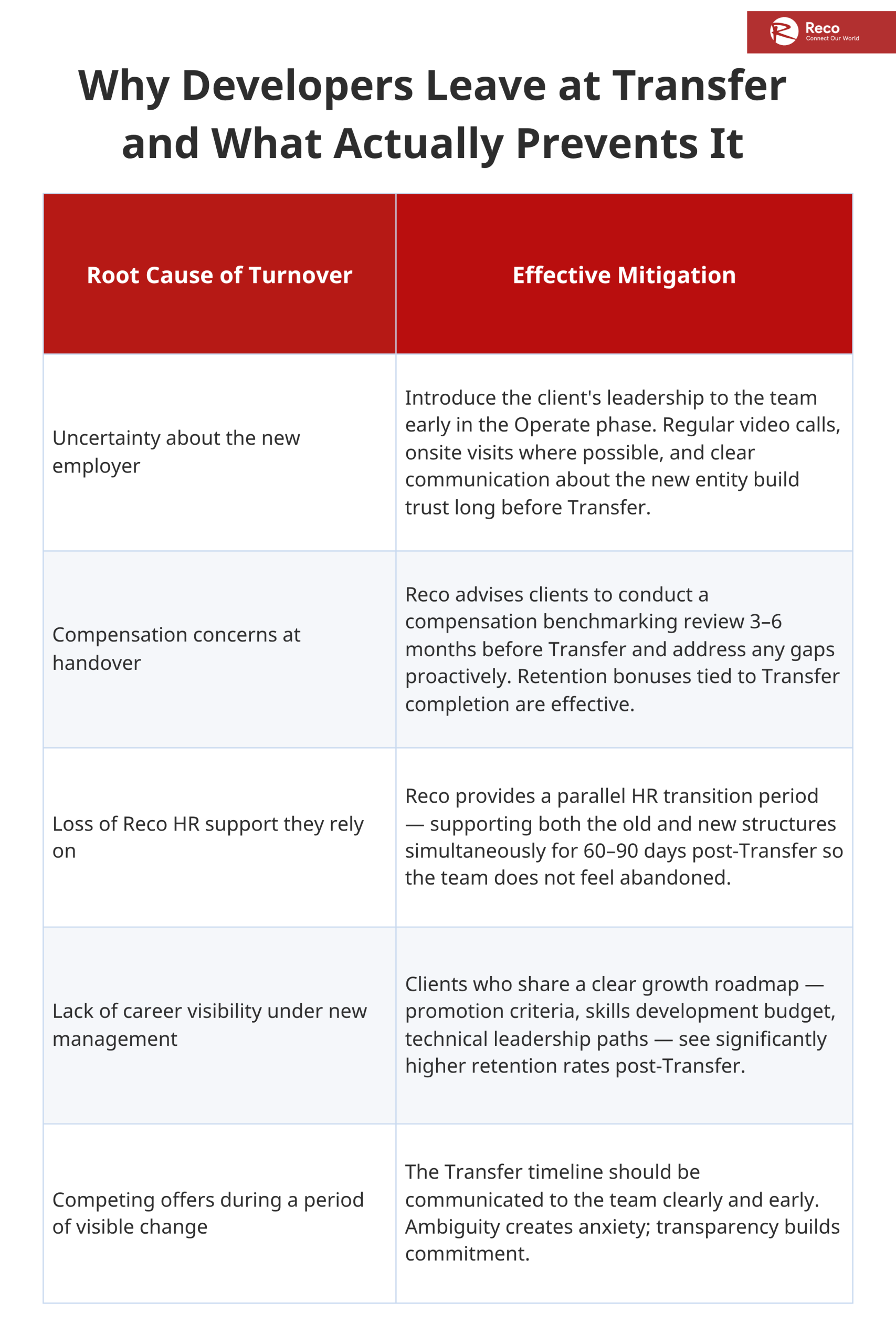
Why Developers Leave at Transfer — and What Actually Prevents It
| Root Cause of Turnover | Effective Mitigation |
| Uncertainty about the new employer | Introduce the client’s leadership to the team early in the Operate phase. Regular video calls, onsite visits where possible, and clear communication about the new entity build trust long before Transfer. |
| Compensation concerns at handover | Reco advises clients to conduct a compensation benchmarking review 3–6 months before Transfer and address any gaps proactively. Retention bonuses tied to Transfer completion are effective. |
| Loss of Reco HR support they rely on | Reco provides a parallel HR transition period — supporting both the old and new structures simultaneously for 60–90 days post-Transfer so the team does not feel abandoned. |
| Lack of career visibility under new management | Clients who share a clear growth roadmap — promotion criteria, skills development budget, technical leadership paths — see significantly higher retention rates post-Transfer. |
| Competing offers during a period of visible change | The Transfer timeline should be communicated to the team clearly and early. Ambiguity creates anxiety; transparency builds commitment. |
Reco’s Retention Protocol During Transfer
Reco actively manages retention as a Transfer readiness metric — not an afterthought. The protocol includes:
- Transfer readiness conversations with every team member 3 months before handover, identifying concerns and escalating to the client where needed.
- Joint onboarding sessions where the client’s HR or engineering leadership formally introduces the new employment structure, compensation, and career development framework.
- A stabilization period of 60–90 days post-Transfer during which Reco remains available for people-related support and escalation.
- Documentation of each team member’s role, performance history, and growth trajectory — handed over to the client’s HR team as part of the Transfer package.
In Reco’s BOT engagements, the majority of team members complete the Transfer and remain with the client long-term. This outcome is designed into the engagement, not left to chance.
[/ux_text]

Looking to hire reliable and highly qualified tech professionals in Vietnam? Reach out to Reco Manpower today for tailored recruitment solutions that match your business needs.
FAQs
Most Reco BOT engagements run between 18 and 36 months from Build initiation to Transfer completion. The Build phase typically takes 4–10 weeks. The Operate phase is agreed at contract stage based on team size and the client’s readiness to manage the team post-Transfer.
No. Reco acts as the employer of record during the Operate phase, handling all local employment, payroll, and compliance on your behalf. You can be fully operational with a Vietnam-based team from week one — no local entity required until Transfer, at which point Reco supports the establishment of your Vietnam subsidiary.
Yes — that is the explicit goal of the build-operate-transfer model. Reco’s Transfer methodology ensures the client receives complete documentation, HR records, IP ownership, and institutional knowledge alongside the team. After Transfer, the team are your permanent employees operating under your direct management. Reco also offers an optional 3–6 month advisory period post-Transfer to ensure a smooth transition.