

1. What Is Employee Morale?
1.1. The Real Meaning of Employee Morale
Employee morale reflects how employees feel about their work, their team, and the organization as a whole. It goes beyond job satisfaction and touches on motivation, emotional connection, and sense of purpose.
In high-performing environments, strong employee morale often shows up through ownership, initiative, and willingness to collaborate. Employees don’t just complete tasks—they actively contribute to outcomes.
On the other hand, when morale declines, engagement drops quietly. Work becomes transactional, and employees start doing only what is required, nothing more.
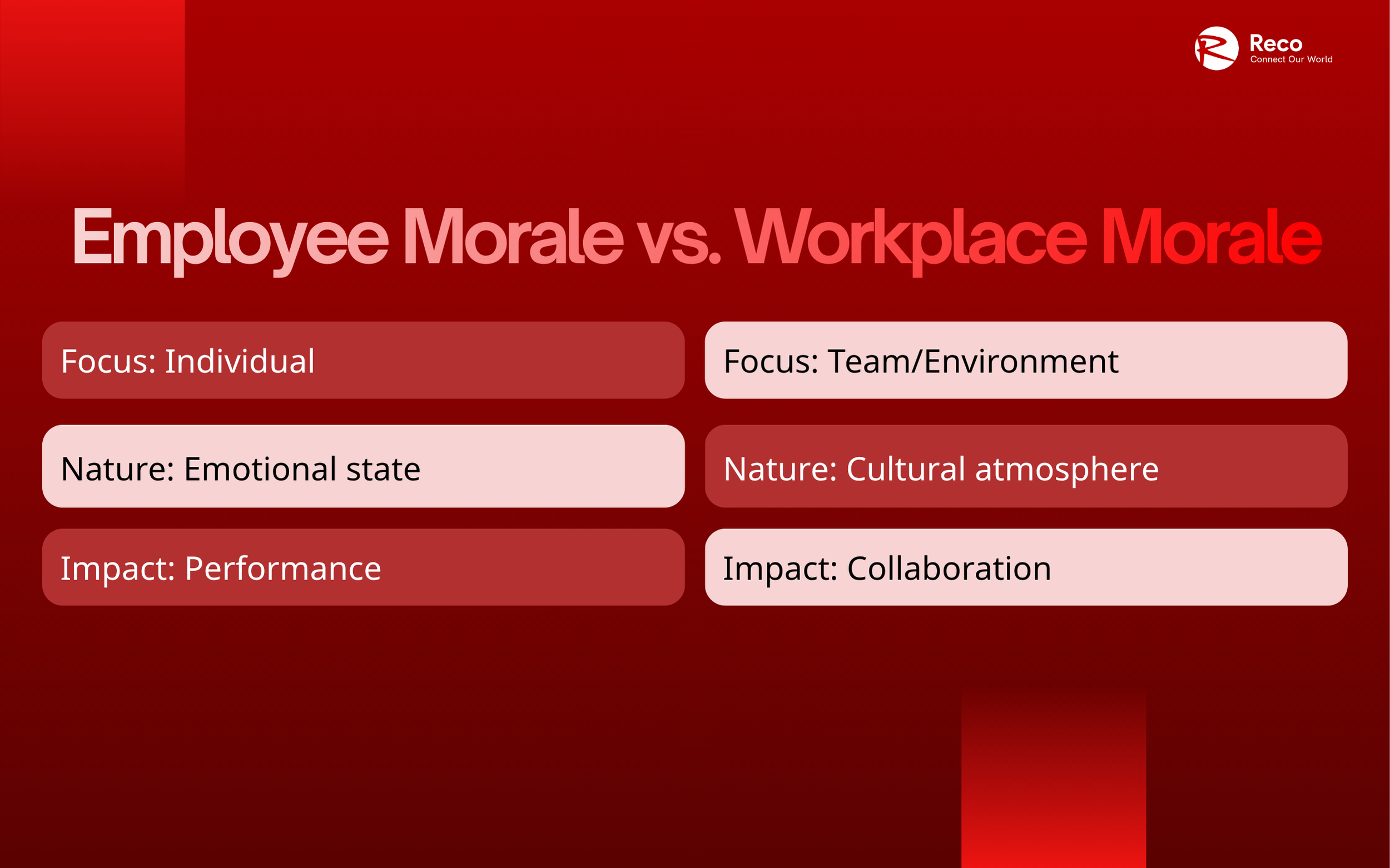
1.2. Employee Morale vs Workplace Morale
While often used interchangeably, employee morale and workplace morale represent two different layers.
| Aspect | Employee Morale | Workplace Morale |
| Focus | Individual | Team/Environment |
| Nature | Emotional state | Cultural atmosphere |
| Impact | Performance | Collaboration |
A strong workplace morale creates the conditions for high employee morale, but if leadership or structure is flawed, even a positive environment won’t sustain individual motivation.
2. Why Employee Morale Matters
2.1. Impact on Productivity
There is a clear connection between employee morale and performance outcomes.
According to Gallup, disengaged employees can cost organizations up to 18% of annual salary in lost productivity. This shows that morale is not just a cultural issue—it is a financial one.
When morale is strong, employees naturally:
- Take ownership of their work
- Solve problems proactively
- Support team members without friction
When morale is low, the opposite happens. Work slows down, mistakes increase, and collaboration becomes forced rather than natural.
Backed by 6+ years of IT HR expertise, Reco helps businesses hire exceptional tech talent across local and global markets — explore what we offer2.2. Impact on Retention and Employer Branding
Many companies assume employees leave because of salary. In reality, declining employee morale is often the deeper cause.
Early signs include reduced participation, slower responses, and quiet disengagement from high performers. Over time, this leads to increased turnover and weakens employer branding in the market.
If you want to understand how team structure impacts retention, you can explore staff augmentation services as a way to balance workload and reduce internal pressure.
3. Common Causes of Low Employee Morale
3.1. Lack of Clarity and Direction
One of the most common causes of low employee morale is confusion. When employees don’t understand priorities or expectations, they struggle to stay motivated.
Unclear direction leads to hesitation, rework, and frustration; all of which gradually reduce morale.
3.2. Poor Leadership and Communication
Leadership directly shapes employee morale. When communication is inconsistent or decisions are not explained, employees start to feel disconnected.
This doesn’t mean leaders need to have all the answers, but they do need to provide clarity and consistency.
3.3. Workload Imbalance and Burnout
Overloading key team members is one of the fastest ways to damage morale.
When employees consistently feel overwhelmed, their engagement drops, even if they were previously high performers. In many cases, companies can address this by restructuring teams or leveraging recruitment services in Vietnam to fill critical gaps.

4. How to Improve Employee Morale Effectively
Improving employee morale is not about quick fixes or isolated initiatives. It requires a combination of clarity, communication, and consistency in how teams are managed. Instead of applying scattered tactics, companies need to focus on a few core drivers that have long-term impact.
4.1. Align Purpose, Expectations, and Communication
Make Work Meaningful and Contextual
Employees are more engaged when they understand the “why” behind their work. Instead of assigning tasks in isolation, leaders should consistently connect individual responsibilities to team outcomes or business goals.
This simple shift helps transform routine work into meaningful contribution, which is a key driver of employee morale.
Create Consistent and Transparent Communication
To improve staff morale, communication needs to be predictable and transparent. This includes:
- Regular check-ins that go beyond task updates
- Clear explanations behind decisions
- Open channels for feedback
When communication becomes consistent, employees feel more secure and less reactive; both of which positively influence morale.
4.2. Build a Recognition and Growth-Driven Environment
Recognize Contributions in a Meaningful Way
Recognition should not be generic or delayed. Employees need to feel that their efforts are seen and appreciated in real time.
Simple but effective ways to boost employee morale include:
- Highlighting specific contributions in meetings
- Encouraging peer recognition
- Acknowledging progress, not just results
The key is consistency. Occasional recognition has limited impact, but regular acknowledgment builds long-term morale.
Provide Clear and Realistic Growth Opportunities
A lack of growth is one of the most overlooked causes of declining employee morale. Employees don’t just want to perform. They want to progress.
This doesn’t always mean promotions. Growth can come from:
- Expanding responsibilities
- Learning new skills
- Taking ownership of projects
When employees see a path forward, they are more likely to stay engaged and committed.
4.3. Manage Workload, Autonomy, and Trust
- Maintain a Sustainable Workload
Overloading high-performing employees is a common but dangerous pattern. While it may work in the short term, it eventually leads to burnout and reduced morale.
To prevent this, companies need to actively monitor workload distribution and ensure that expectations remain realistic over time.
- Replace Control with Trust and Ownership
Micromanagement is one of the fastest ways to damage employee morale. It signals a lack of trust and reduces employees’ sense of ownership.
To improve staff morale, leaders should focus on:
- Setting clear outcomes instead of controlling processes
- Giving employees flexibility in how they work
- Trusting teams to deliver without constant oversight
When employees feel trusted, they naturally become more responsible and engaged.
- Support Recovery and Work-Life Balance
Sustainable performance depends on recovery. Encouraging employees to take breaks, use their leave, and disconnect after work is essential to maintaining long-term employee morale.
Companies that ignore this often see short-term productivity gains followed by long-term disengagement.
5. Ways to Improve Staff Morale in Remote Teams
5.1. Build Real Connection, Not Just Communication
In remote environments, one of the biggest challenges affecting employee morale is the lack of genuine human connection. Conversations often become purely task-focused, which over time makes employees feel isolated from the team.
To improve workplace morale in remote settings, companies need to go beyond work-related communication. Creating space for informal interactions (such as virtual coffee chats or casual team check-ins) helps rebuild the sense of belonging that naturally exists in physical offices.
When employees feel connected as people, not just contributors, employee morale improves significantly.
5.2. Make Work Visible and Meaningful
One of the hidden issues in remote teams is that employees often feel their work goes unnoticed. This invisibility can quietly reduce employee morale, even when performance is strong.
Leaders should actively highlight contributions, share progress updates, and connect individual efforts to team outcomes. Something as simple as acknowledging a completed task in a team channel can reinforce a sense of value.
5.3. Build Trust Instead of Control
Remote work can sometimes lead to over-management. Frequent check-ins, constant monitoring, or unclear expectations can unintentionally create pressure rather than support.
To truly improve staff morale, leaders need to shift from control to trust. This means setting clear goals, giving employees ownership, and allowing flexibility in how work gets done.
When trust becomes the default, employees feel more empowered and that directly strengthens employee morale.

6. How Reco Helps Companies Improve Employee Morale at Scale
Improving employee morale is not just about internal effort. It also depends on having the right people, the right structure, and the right support system in place.
At Reco, we work closely with companies to solve one of the root causes of low morale: hiring mismatch and team imbalance.
6.1. Build the Right Team, Not Just Fill Roles
Many companies struggle with employee morale because they hire based on urgency rather than long-term fit. This often leads to:
- Misaligned expectations
- Increased workload for existing team members
- Friction in collaboration
Through recruitment services in Vietnam, Reco helps businesses find candidates who can contribute from day one and integrate smoothly into existing teams.
6.2. Scale Teams Without Breaking Morale
Rapid scaling can easily disrupt workplace morale if not managed properly. Teams become overloaded, communication breaks down, and expectations become unclear.
With staff augmentation services, companies can scale flexibly – bringing in the right talent at the right time without overburdening internal teams.
This approach helps maintain stability while still supporting business growth.
6.3. Ensure Stability Through Compliance and Payroll Support
Operational issues (such as payroll delays, unclear contracts, or compliance risks) can negatively impact employee morale more than many companies realize.
Reco’s Payroll services ensure that employees are paid accurately, on time, and in full compliance with local regulations. This creates a stable foundation where employees can focus on their work instead of worrying about administrative issues.
7. Conclusion
Employee morale is not something that can be fixed with quick wins or temporary initiatives. It is built through consistent leadership, meaningful communication, and a work environment where people feel valued.

Looking to hire reliable and highly qualified tech professionals in Vietnam? Reach out to Reco Manpower today for tailored recruitment solutions that match your business needs.
FAQs
Low employee morale rarely shows up immediately in performance metrics. Early signals often include reduced participation in discussions, slower response times, and a noticeable decline in proactive behavior.
These subtle shifts are often stronger indicators than KPIs and should be monitored as part of any workplace morale strategy.
In high-growth environments, unclear or inconsistent leadership can quickly damage employee morale.
When priorities shift frequently without explanation, employees may feel disconnected or overwhelmed. To boost employee morale, leaders need to balance speed with clarity; ensuring that teams understand not just what to do, but why it matters.
Many companies assume improving morale requires additional budget, but some of the most effective ways to improve staff morale are operational. Clear communication, fair workload distribution, and timely recognition often have a stronger impact than financial incentives.
These are sustainable methods to improve staff morale without increasing overhead.
Hybrid teams often experience uneven workplace morale, where some employees feel more connected than others.
To address this, companies need to standardize communication practices and ensure equal visibility across both remote and in-office employees. Consistency is key when deciding how to improve staff morale in hybrid setups.