
1. What is a Work Environment
When people think about what is a work environment, they often imagine a physical office or workplace setup. In reality, the concept is broader and more complex. A work environment reflects how employees experience their work daily, including culture, leadership, communication, and systems.
1.1. The real meaning of working environment
The meaning of working environment goes beyond visible elements. It combines both physical and non-physical factors that shape how employees think, behave, and perform.
- Physical vs non-physical factors
The physical environment includes office layout, equipment, and good working conditions such as safety, comfort, and resources. These elements matter, but they are only one part of the overall environment of work.
Non-physical factors are often more influential. These include company culture, leadership style, communication patterns, and decision-making processes. Together, they determine whether employees feel supported, trusted, and motivated.

- How environment of work shapes employee experience
A well-designed work environment influences how employees interact, solve problems, and make decisions. It affects whether people feel confident sharing ideas, whether they collaborate effectively, and whether they stay engaged over time.
In practice, the workforce environment defines not just where people work, but how they experience work. Many companies improve this by aligning hiring and team structure through models like IT staffing in Vietnam.
1.2. Why work environment matters
Understanding what is a work environment is not just theoretical. It directly influences how teams perform and how businesses grow.
- Impact on productivity and collaboration
A strong work environment creates clarity and alignment. Employees know what is expected, how to communicate, and how to collaborate. This reduces friction and improves execution speed.
In contrast, a weak environment leads to confusion, duplicated effort, and slow decision-making.
- Impact on retention and employer branding
Employees are more likely to stay in organizations where they feel supported and valued. A positive work environment strengthens employer branding and makes it easier to attract talent.
On the other hand, companies with poor environments often struggle with retention, even when compensation is competitive. This is a key factor in what makes a good workplace in practice.

2. Why Most Companies Get Work Environment Wrong
Many companies believe they have a strong work environment, but in reality, they optimize for what is visible rather than what actually impacts employee experience. This gap between perception and reality is one of the main reasons workplace environments fail to deliver long-term results.
2.1. Confusing perks with good working conditions
One of the most common mistakes is equating perks with a good work environment. Free snacks, office design, or team activities may improve short-term satisfaction, but they do not define good working conditions.
What truly matters is how work is structured, how decisions are made, and how employees are treated on a daily basis.
2.2. Ignoring leadership and communication
Leadership plays a central role in shaping the environment of work, yet it is often overlooked. Poor communication, unclear expectations, or inconsistent management can quickly undermine even the best-designed workplace.
In many cases, the real issue is not the environment itself, but how it is managed.
3. What Makes an Ideal Work Environment

An ideal work environment is not created through perks or policies alone. It is built through consistent systems that support performance, trust, and growth.
3.1. Core elements of an ideal workplace environment
- Clear communication and expectations
Employees perform better when expectations are clear. Transparency in goals, roles, and feedback reduces confusion and enables faster decision-making.
- Trust and psychological safety
An ideal work environment allows employees to share ideas, ask questions, and admit mistakes without fear. Psychological safety is essential for innovation and effective collaboration.
With 6+ years of HR expertise in the IT industry, Reco delivers high-caliber tech talent to local and global companies - Explore Our Services3.2. Growth and flexibility in modern work
- Career development and learning
Employees are more engaged when they see opportunities to grow. Training programs, mentorship, and clear career paths contribute to a stronger workforce environment.
- Flexibility and autonomy
Flexibility is no longer optional. Whether through remote work or flexible schedules, autonomy allows employees to manage their time and maintain balance.
Many companies support this flexibility by adopting scalable workforce models such as staff augmentation
4. Ideal Work Environment vs Good Working Conditions
4.1. What is the difference
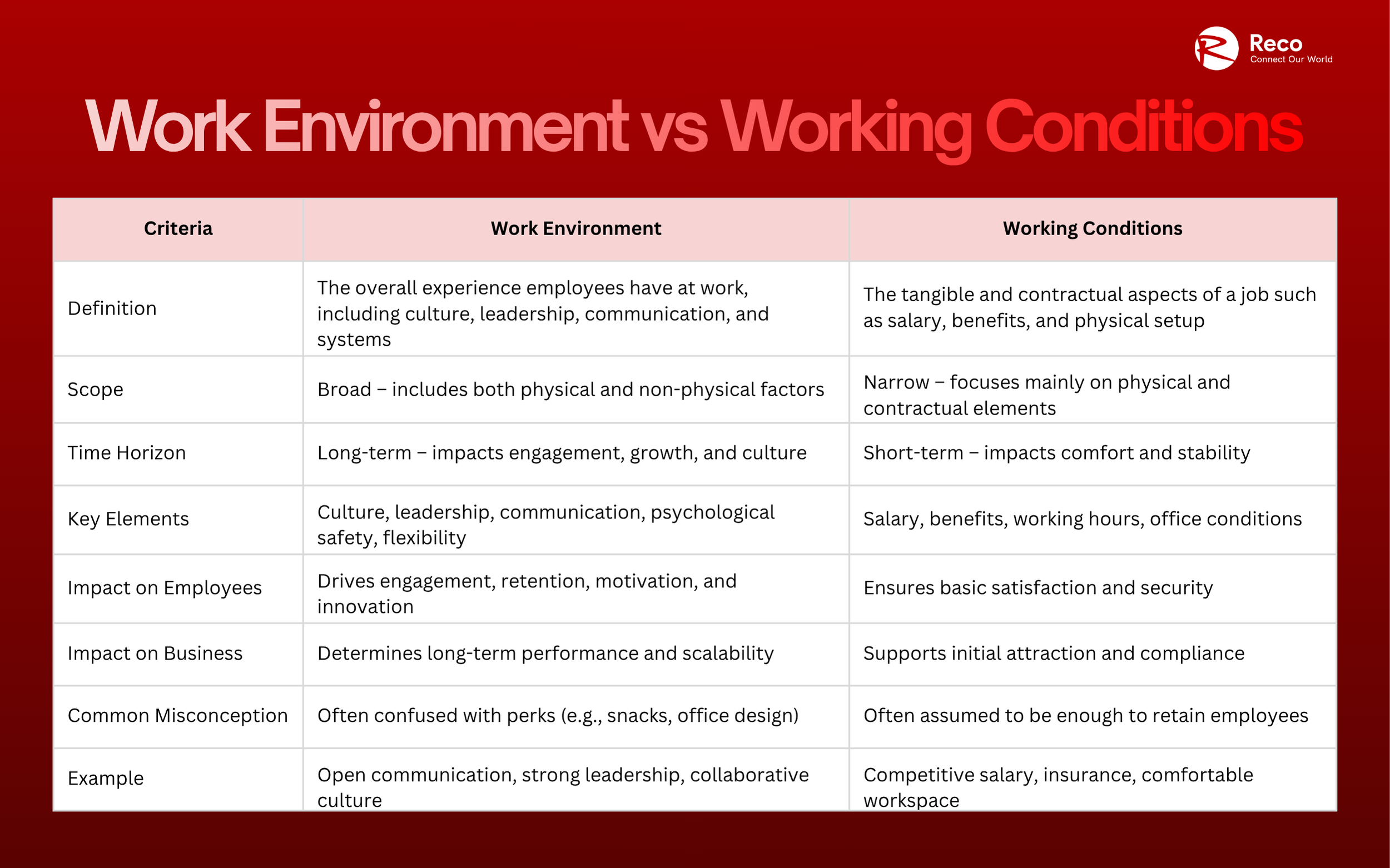
An ideal work environment focuses on long-term employee experience, including culture, leadership, and growth. In contrast, good working conditions refer to more immediate and tangible factors such as salary, benefits, and physical setup.
| Aspect | Ideal Work Environment | Good Working Conditions |
| Focus | Experience and culture | Physical and contractual factors |
| Time horizon | Long-term | Short-term |
| Impact | Engagement and growth | Stability and comfort |
4.2. Why both matter for business performance
Both elements are necessary. Good working conditions provide the foundation, while a strong environment drives engagement and performance.
In practice, companies often rely on structured solutions like payroll outsourcing to maintain consistent and compliant working conditions across markets.
5. How to Describe Workplace Environment Effectively
Being able to describe workplace environment clearly is essential for attracting the right talent.
5.1. What candidates actually look for
Candidates are no longer satisfied with generic descriptions. They want to understand how the company operates, how decisions are made, and how teams collaborate.
A strong description should reflect the real meaning of working environment, not just surface-level benefits.
Backed by 6+ years of IT HR expertise, Reco helps businesses hire exceptional tech talent across local and global markets — explore what we offer5.2. Example of a strong workplace description
A clear and effective way to describe workplace environment might look like this: “Our work environment is built on transparency, collaboration, and continuous learning. Employees are encouraged to take ownership of their work while receiving ongoing support from their managers.”

This approach helps candidates understand what makes a good workplace before they join.
6. How Reco Manpower Supports Better Work Environments
At Reco Manpower, building a strong work environment starts with aligning talent, structure, and business goals.
Reco supports companies by:
- Providing access to qualified IT talent
- Enabling flexible workforce models
- Supporting team scaling without operational friction
This allows companies not only to hire faster, but also to build a more effective and sustainable ideal work environment from the start.
7. Conclusion
So, what is a work environment? It is not just a physical space or a set of benefits, but the overall system that shapes how employees experience their work. Understanding what is a work environment helps businesses move beyond surface-level improvements and build workplaces that truly support performance, engagement, and long-term success. Ultimately, this is what defines what makes a good workplace in today’s competitive talent market.
Looking to hire reliable and highly qualified tech professionals in Vietnam? Reach out to Reco Manpower today for tailored recruitment solutions that match your business needs.
FAQs
The environment of work and workplace culture are closely related but not identical. Workplace culture reflects shared values, beliefs, and behaviors, while the work environment includes both culture and structural factors such as leadership, processes, and good working conditions.
In practice, culture influences how people behave, while the workforce environment determines how work actually happens.
Understanding what makes a good workplace today requires looking beyond traditional factors like salary or office space. Employees now value:
- Clear expectations and communication
- Flexibility and autonomy
- Opportunities for growth
- Supportive leadership
These elements together create an ideal work environment that supports both performance and well-being.
Measuring a work environment requires both qualitative and quantitative approaches. Companies often rely on:
- Employee engagement surveys
- Feedback loops and 1-on-1 discussions
- Retention and turnover rates
- Productivity and collaboration metrics
The key is not just collecting data, but identifying patterns that reflect the real meaning of working environment in practice.
Remote and hybrid work have significantly changed the environment of work. Physical space becomes less important, while communication, trust, and clarity become critical.
Companies need to intentionally design their workforce environment to ensure alignment, especially when teams are distributed across locations. Without strong systems, flexibility can lead to fragmentation instead of productivity.
Hiring plays a foundational role in shaping the work environment. The way companies source, evaluate, and onboard talent directly impacts team dynamics and culture.
For example, using structured hiring approaches such as IT staffing in Vietnam or flexible models like staff augmentation allows companies to build teams that align better with their desired environment of work.
Yes, and this is more common than many companies realize. A company may offer competitive salaries and benefits (strong good working conditions), but still have poor communication, weak leadership, or unclear expectations.
In such cases, employees may feel dissatisfied despite the benefits. This highlights the difference between surface-level conditions and the deeper meaning of working environment.