
1. What Is a Performance Appraisal?
A performance appraisal is a structured process for evaluating employee performance against predefined standards. It informs compensation, promotion, development planning, and organizational alignment — making it one of the most consequential recurring processes in any HR function.
Quick answer: Performance appraisal is the systematic evaluation of an employee’s job performance, used to guide compensation, promotion, training, and development decisions.
The global performance management software market was valued at $5.82 billion in 2024, projected to reach $12.17 billion by 2032. Organizations with consistent feedback cycles report 39% higher talent attraction effectiveness and 44% better retention than those running purely annual reviews.
2. Where Performance Appraisal Sits in the Employee Lifecycle
Performance appraisal is primarily a Development & Engagement stage tool — but its impact extends across Retention and Exit as well.
The standard employee lifecycle runs: Attraction → Recruitment → Onboarding → Development & Engagement → Retention → Exit. Appraisal touches the last three in distinct ways:
- Development & Engagement — the primary stage. Appraisals identify skill gaps, surface promotion readiness, and set the direction for individual growth. This is where process quality matters most.
- Retention — appraisal quality is a direct retention signal. Employees receiving unclear or inconsistent feedback disengage quietly before they leave. How an organization runs its reviews communicates how seriously it treats its people.
- Exit — appraisal data analyzed alongside exit interviews reveals systemic patterns: teams with weak feedback culture, roles where criteria drifted from actual expectations, managers whose ratings consistently misaligned with market realities.
What This Looks Like in Vietnam
In Vietnam, most enterprises have a performance appraisal process on paper — the gap is in execution. According to a 2024 survey of 1,200 HR managers by Tanca, 62% use a combination of MBO and competency-based evaluation, 23% are transitioning to OKR, and 15% apply 360-degree feedback.
From Reco Manpower’s experience across technology, manufacturing, and professional services mandates, three execution gaps appear most consistently:
No cadence. Reviews happen once a year — triggered by salary season, not development need. The appraisal becomes a compensation justification exercise rather than a genuine performance conversation.
Criteria lag. In fast-growing companies, appraisal standards don’t keep pace with how roles actually evolve. The result is employees evaluated against outdated expectations, eroding trust on both sides.
Manager capability gap. The bottleneck is rarely the form — it’s the manager running it. Mid-level managers promoted for technical skill often lack the confidence to deliver candid, development-oriented feedback. Deploying an appraisal system without building manager capability produces compliance, not impact.
Reco Manpower partners with businesses across Vietnam and the region to build structured, scalable HR practices — from recruitment through performance management. Connect with our team to learn more.3. 7 Core Principles of Effective Performance Appraisal
The method chosen matters far less than whether these seven principles are in place — without them, even the most sophisticated appraisal framework underdelivers.
- Clarity of criteria — Employees must know the standards they’ll be evaluated against before the review cycle begins, not at the moment of evaluation.
- Consistency and fairness — The same criteria must apply across comparable roles. Calibration sessions — where managers align ratings collectively — are the primary safeguard against drift and favoritism.
- Two-way dialogue — Effective appraisals are conversations, not verdicts. The manager brings data; the employee brings context and aspirations. The output is a shared development plan.
- Timeliness — Feedback loses value when delayed. Employees receiving meaningful weekly feedback report full engagement at 80% — significantly above those receiving only annual reviews.
- Development orientation — The goal is improving the future, not documenting the past. Appraisals that balance accountability with investment in growth outperform those that treat evaluation as an endpoint.
- Data integrity — Evaluations should draw on documented evidence throughout the cycle — project outcomes, behavioral observations, measurable KPIs — not end-of-year impressions.
- Strategic alignment — Individual performance criteria should connect to team and organizational goals. When employees see how their work contributes to broader outcomes, the appraisal becomes a strategic tool rather than an administrative one.
4. 7 Modern Performance Appraisal Methods for 2026
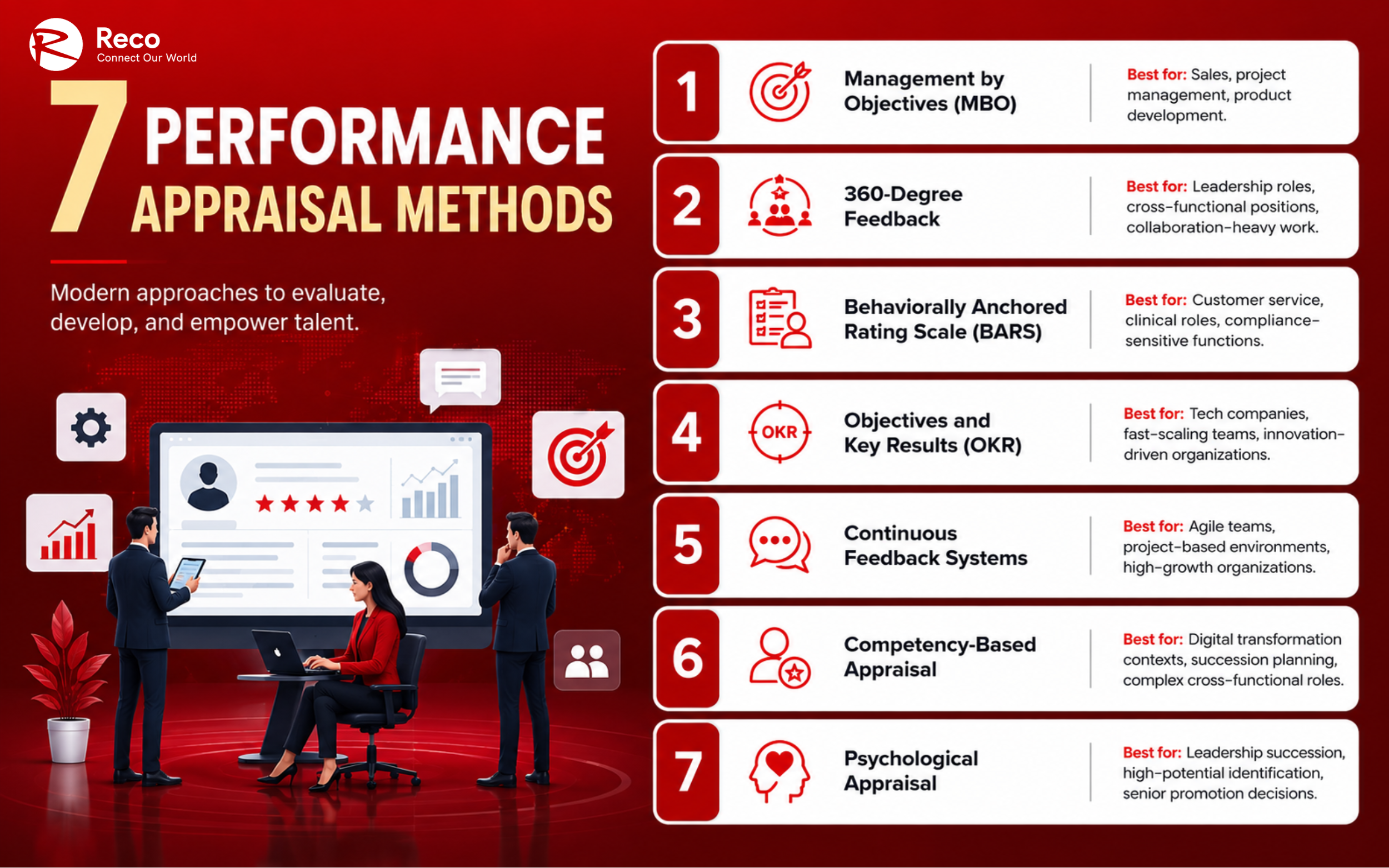
No single method fits every organization — the right choice depends on role type, team size, culture, and review frequency. Traditional approaches (forced rankings, trait-based checklists) are giving way to methods that emphasize measurable behavior, continuous feedback, and multi-source input.
1. Management by Objectives (MBO)
Managers and employees collaboratively set specific, measurable goals; performance is evaluated against agreed outcomes. Transparent, results-oriented, and widely applicable. In 2026, MBO is increasingly integrated with AI-assisted goal-tracking that flags stale or misaligned objectives mid-cycle rather than at year-end.
Best for: Sales, project management, product development.
2. 360-Degree Feedback
Gathers evaluations from managers, peers, subordinates, and sometimes clients — plus a self-assessment. Provides a multi-dimensional view of performance no single-rater system can replicate. AI-powered NLP tools now analyze open-text 360 feedback at scale, surfacing themes and sentiment patterns efficiently.
Best for: Leadership roles, cross-functional positions, collaboration-heavy work.
3. Behaviorally Anchored Rating Scale (BARS)
Anchors each rating point to a concrete behavioral description rather than a vague numerical scale. Reduces evaluator subjectivity and produces more defensible, consistent assessments. AI is now being used to generate behavioral anchors from job descriptions and historical data, lowering the setup cost that previously made BARS inaccessible for smaller organizations.
Best for: Customer service, clinical roles, compliance-sensitive functions.
4. Objectives and Key Results (OKR)
OKRs operate on quarterly cycles, are visible across the organization, and embrace ambitious stretch goals. They connect the what (objective) with the how (key results), making them more dynamic than traditional MBO. Platforms like Workday and Microsoft Viva Goals now offer AI-assisted goal suggestions calibrated to company-wide performance trends.
Best for: Tech companies, fast-scaling teams, innovation-driven organizations.
5. Continuous Feedback Systems
Embeds performance conversations into the regular rhythm of work — frequent check-ins, real-time feedback, development actions triggered in the moment rather than deferred. AI platforms automate feedback prompts, track sentiment trends, and flag early burnout indicators, enabling proactive HR intervention. Organizations with mature implementations report up to 40% improvement in retention.
Best for: Agile teams, project-based environments, high-growth organizations.
Read more: Employee Retention: Strategies to Improve Retention and Keep Top Talent6. Competency-Based Appraisal
Evaluates the underlying skills, behaviors, and capabilities that drive sustained performance — not just task outputs. Particularly valuable in industries where roles evolve faster than job descriptions. As skills-based organizations become the dominant talent model, competency-based appraisal is the natural evaluation mechanism. AI-driven skills mapping tools are making competency inventory management more dynamic and current.
Best for: Digital transformation contexts, succession planning, complex cross-functional roles.
7. Psychological Appraisal
Assesses future potential — cognitive ability, personality traits, leadership qualities, emotional intelligence — rather than past performance. Conducted by qualified assessors, these evaluations are inherently more predictive. AI-assisted psychometric tools are improving scalability and reducing cost, though compliance requirements (including the EU AI Act) demand rigorous governance.
Best for: Leadership succession, high-potential identification, senior promotion decisions.
5. AI in Performance Appraisal: Opportunity and Limits
AI is most effective in performance appraisal as a support layer — reducing administrative burden and surfacing patterns — but cannot replace the human judgment that makes evaluations fair and contextually accurate.
By 2025, AI-driven appraisal tools reached a 32% adoption rate in mid-size enterprises, and SHRM’s State of AI in HR 2026 report found that 62% of organizations have AI deployed somewhere in their HR function.
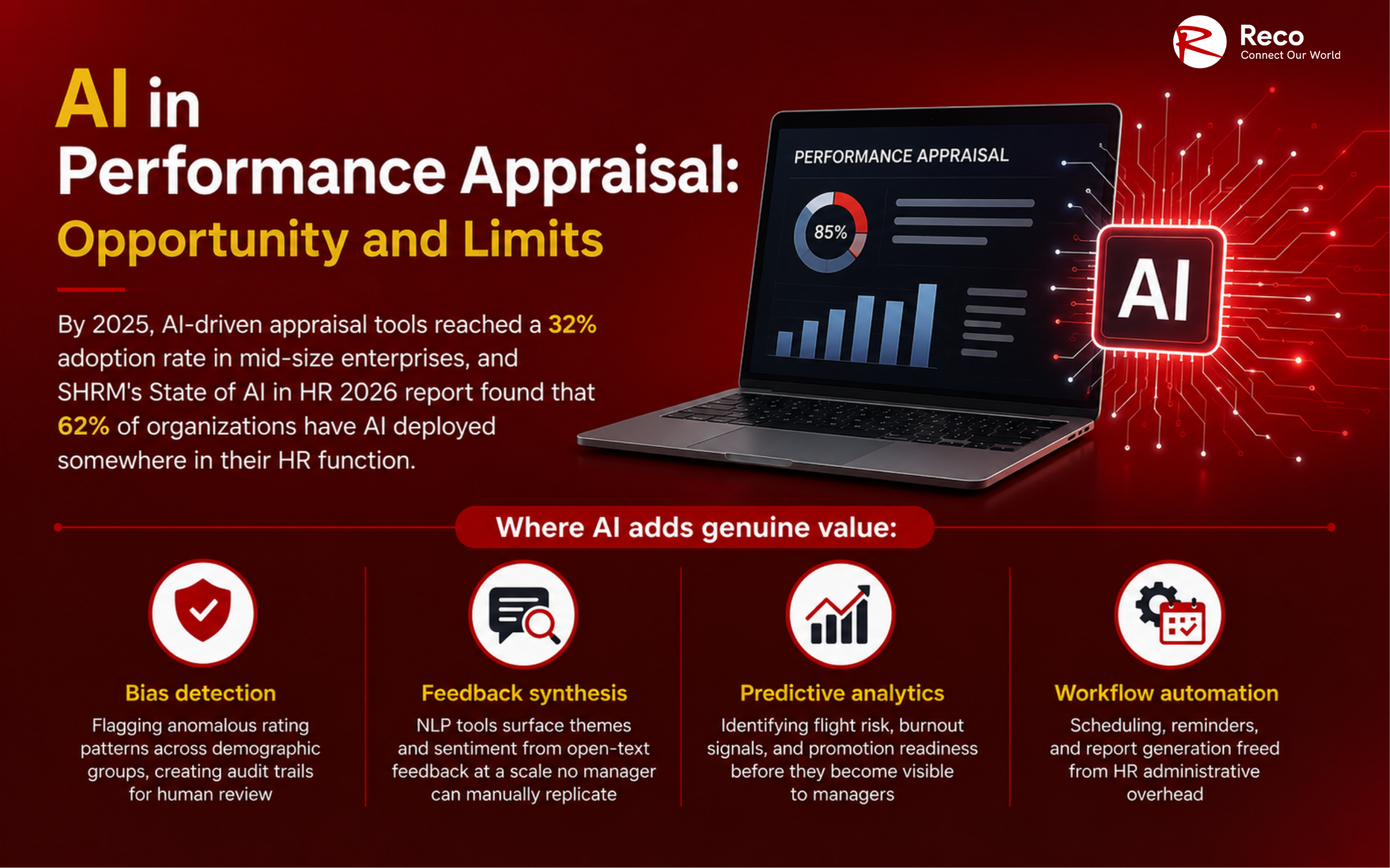
Where AI adds genuine value:
- Bias detection — flagging anomalous rating patterns across demographic groups, creating audit trails for human review
- Feedback synthesis — NLP tools surface themes and sentiment from open-text feedback at a scale no manager can manually replicate
- Predictive analytics — identifying flight risk, burnout signals, and promotion readiness before they become visible to managers
- Workflow automation — scheduling, reminders, and report generation freed from HR administrative overhead
Where human judgment remains essential: Gartner notes that only 1 in 50 AI investments delivers transformational value. The pattern is consistent: AI performs well on structured, historical data — and poorly on context. An employee delivering below-target output during a restructuring, personal crisis, or market disruption needs a human interpreter between the data and the decision. AI systems also inherit the biases in the data they’re trained on, making regular audits non-negotiable.
Deloitte’s 2026 guidance is direct: standardize processes first, then layer AI on top. Deploying AI over inconsistent performance data doesn’t improve the process — it automates its flaws.
6. Common Mistakes That Undermine Appraisal Effectiveness
Well-designed appraisal systems still fail — most often due to the same five execution errors.
Recency bias — weighting recent weeks over the full review period. Corrected by structured documentation throughout the cycle.
Rating inflation — inflating scores to avoid difficult conversations. Corrected by cross-manager calibration sessions.
Read more: Employee Morale: Why It Drops and Proven Ways to Improve Staff MoraleOne-way feedback — delivering appraisals as verdicts rather than conversations. Generates resentment, not development.
Misaligned criteria — evaluating against standards that don’t reflect actual role requirements, producing inaccurate assessments and legal exposure.
Treating AI output as final — using AI-generated scores without human review removes the contextual judgment that makes appraisals fair.
7. Final Thought
The method matters less than the consistency, fairness, and quality of conversation it enables. In 2026, the most effective appraisal processes combine structured evaluation with continuous dialogue — and use AI to support human judgment, not replace it.

Looking to hire reliable and highly qualified tech professionals in Vietnam? Reach out to Reco Manpower today for tailored recruitment solutions that match your business needs.
FAQs
For high-growth sectors and agile teams, traditional graphic rating scales often fail because roles evolve faster than job descriptions. The most effective frameworks include Management by Objectives (MBO) and Objectives and Key Results (OKR) for clear, data-driven alignment, combined with 360-Degree Feedback to capture cross-functional collaboration. When scaling distributed tech teams, Reco Manpower recommends integrating Continuous Feedback Systems to insulate sprints against mid-year attrition and keep performance metrics synchronized in real-time.
In 2026, AI acts as an essential operational engine—not a final decision-maker. Advanced natural language processing (NLP) tools can synthesize large volumes of open-text 360 feedback, flag anomalous rating patterns to detect systematic bias, and automate scheduling reminders to eliminate administrative overhead. However, as Reco Manpower advises its enterprise partners, human judgment remains irreplaceable; AI should be layered over a standardized, well-calibrated process to support, rather than replace, strategic human interpretation.
While traditional processes treat performance reviews strictly as an administrative tool for salary adjustments, a modern performance appraisal serves as a strategic driver for employee lifecycle development. It bridges the gap between organizational objectives and individual growth. By partnering with an end-to-end HR consultant like Reco, enterprises can leverage appraisals to uncover critical skill gaps, identify high-potential leaders for succession planning, and structurally improve retention by aligning employee output with corporate velocity.